
Designing AI-Resilient Assessments with the PROTECT Framework
The Honest Truth about AI and Grading
The rise of generative AI has quietly shifted a lot of faculty energy toward one question: Did my student actually write this? And that’s an exhausting place to spend your time. Verifying authorship, wondering if a suspiciously polished paragraph is a red flag—this is probably not why you were drawn into teaching. The joy of the profession lives somewhere else entirely.
What you’re really looking for when you read student work is presence. A real voice. Evidence that someone sat with a difficult idea and wrestled with it. The goal was never compliance—it was growth.
So, what if instead of building taller walls around assessments, we designed assessments that AI simply can’t shortcut? It’s a question my fellow researchers and I kept coming back to—and one that ultimately guided the research behind the PROTECT framework.
Where the PROTECT Framework Came From
Our research began in a Logic and Digital Design course at UW-Platteville in Fall 2024. Engineering students spent the semester building and testing small robot cars. Over six virtual and four physical labs, the students designed vehicles to follow lines, detect obstacles, and react in real time. Their work culminated in a live competition on a replica of the Road America track.
Watching that process up close is what sparked the PROTECT framework. Because students were building their vehicles from scratch, they were constantly running into problems. At one point, they faced the challenge of how to stop a car that can only detect obstacles when they’re about two inches away. During our research, we posed this same problem to an AI tool, which suggested things like increasing track friction or slowing the car down—ideas that were reasonable but generic and didn’t really solve the issue.
On the other hand, students landed on something the AI never would have through their own hands-on trial and error. They came up with briefly reversing the motor direction to cancel the car’s momentum. That solution didn’t come from a prompt. It came from students physically handling the hardware, feeling what happened, and iterating.
That contrast—generalized AI logic versus the kind of thinking that only emerges from doing—became the foundation of the PROTECT framework (Ma et al., 2024).
By the end of the semester, the impact of instituting the framework showed up clearly in the assessments themselves. Out of approximately 230 assessments, we observed only one AI-generated submission attempt. Scores rose, the course’s pass rate climbed to 96%, and student performance was more consistent.
We then realized this framework wasn’t just a way to make assignments more AI-resilient in engineering courses—it was a teaching principle worth sharing more broadly.
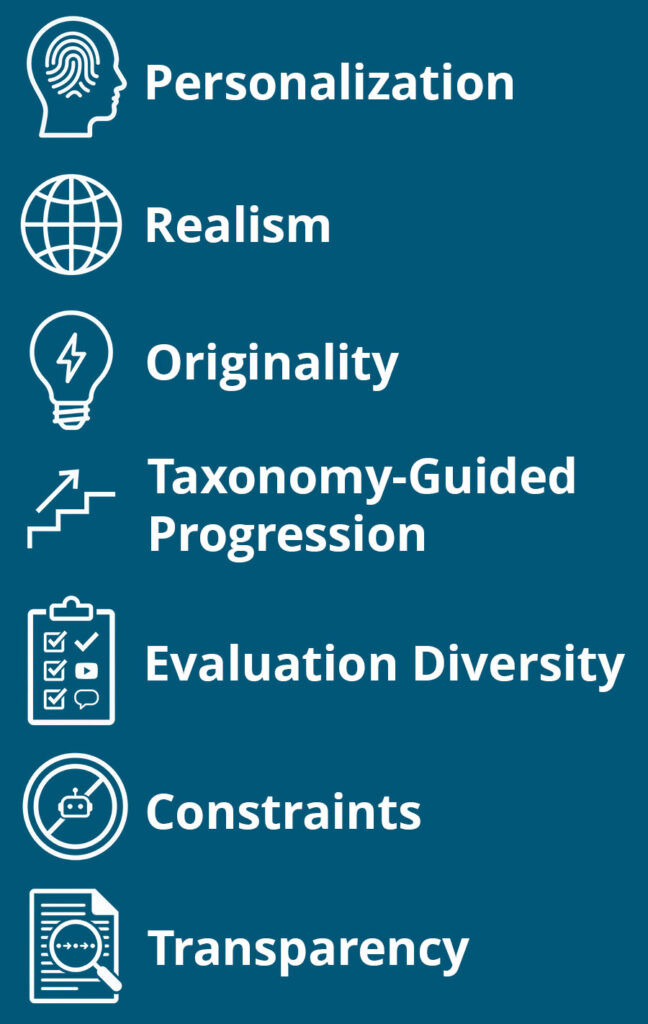
The Seven PROTECT Pillars
The PROTECT framework embeds authenticity into assessment design through seven interconnected pillars and can be used in any field of study. Here are the seven pillars:
- Personalization: Tailor tasks to each student’s unique background, context, or lived experience.
- Realism: Incorporate real-world complexity that AI struggles to replicate.
- Originality: Move beyond text to videos, physical prototypes, or recorded demonstrations.
- Taxonomy: Structure assessments through increasingly complex cognitive steps.
- Evaluation Diversity: Vary how you assess—consider peer reviews, oral defenses, or process artifacts.
- Constraints: Set clear boundaries for appropriate AI use (rather than banning it outright).
- Transparency: Ask students to document exactly how and where they used AI.
While the framework supports academic integrity, that’s almost secondary. Its true purpose is to create assessments so relevant, engaging, and personal that students naturally take ownership of their learning.
Rethinking a Standard Assessment
Consider a foundational course in communications or leadership. A common prompt might look like this:
“Write a 500-word essay analyzing the common barriers to effective communication.”
An AI tool can produce a polished, citation-ready paper on that topic in minutes—and the student learns very little in the process.
Now, apply a few PROTECT pillars:
- Personalization + Realism: Ask students to identify a specific communication breakdown they experienced—a tense group project, a scheduling conflict in a student organization, or even a tricky roommate situation.
- Originality + Evaluation Diversity: Drop the essay format. Instead, ask for a brief, three-minute audio memo reflecting on that breakdown. Students apply the week’s conflict-resolution concepts to explain what went wrong and how they’d handle it differently today.
- Transparency: Ask them to submit a short log showing exactly how they used AI—to brainstorm talking points or role-play the conversation beforehand.
With this approach, the assessment isn’t just more resilient to AI—it’s a genuinely richer learning experience. It calls for a real voice, a lived memory, and the kind of human nuance that algorithms can’t replicate. As our research notes, this kind of design “reinforces the human-centric nature of authentic learning, preparing students for a technology-driven world while preserving the core values of critical thinking and practical application.”
The good news is that you don’t need to redesign your entire course to get started. The OPLR team has translated this research into a quick, discipline-neutral resource you can use right away: the AI-Resilient Assessments Tip Sheet. It focuses on small, targeted adjustments to assessments you’re already using—no overhaul required.
As always, the instructional design team is here to partner with you. Whether you’re making a small tweak or rethinking a larger assignment, we’re happy to help you apply the PROTECT framework in ways that fit your course and your goals. Even a few thoughtful changes can go a long way in creating assessments that invite real thinking, real engagement, and real learning.
Reference
Ma, X., Wu, Y., Roopaei, M., & Wang, J. (2024). WIP: PROTECT: A framework for preserving project-based learning integrity in the AI era. Frontiers in Education (FIE).

This article was written by Jing Wang, MS, Instructional Designer, Cybersecurity and AI-Enhanced Learning Initiatives.