Telling Stories with Media: Two Collaborative Approaches
Storytelling is one of the most effective pedagogical tools we have. It provides structure, context, and meaning for students at all levels. Two recent OPLR media projects show how story-driven design can turn complex ideas into clear, compelling learning experiences.
Transforming an Infographic into a Story-Based Learning Experience
The first example comes from a project in which ITM faculty member Amber Leibundgut-Peterson wanted to adapt an extensive infographic comparing managers and leaders into a short video. While the infographic contained valuable information, its density made it difficult for students to quickly grasp the key takeaways. By shifting to video rather than a static graphic, instructor Leibundgut-Peterson was able to focus on the points she found most important.
Instructor Leibundgut-Peterson used elements of storytelling to bring the infographic to life, narrating it from a script she wrote to give a human voice to ideas that might otherwise feel abstract. The story highlights the different paths and perspectives managers and leaders take in various situations, with concepts unfolding naturally as the narrative progresses.
The Media Team created “characters” to represent these abstract concepts visually, using custom graphics to show each character’s perspective and how they might respond to common scenarios.
By framing the comparison as a guided narrative rather than a static list, students are guided through the material in a way that feels authentic and memorable. The finished product also offers accessible audio narration, transcripts, and captions, ensuring that every learner can engage with the story. This shift demonstrates how even highly conceptual content can become more meaningful when wrapped in a story.
*If the video fails to load, you can see the finished piece on the Media website.
Bringing Counseling Concepts to Life Through Character-Driven Stories
In Foundations of Clinical Mental Health Counseling, storytelling operates at a larger scale, with a story woven through the entire course. Faculty member Dr. Jenais Y. Means created a rich narrative world featuring a recurring cast of “colleagues,” each at different stages in their counseling careers and working across varied settings, from private practice to community mental health to integrated clinics.
Using a narrative format exposes first-year Clinical Mental Health Counseling master’s students to the diverse realities of the profession. As common professional issues arise, such as ethical considerations, coverage requirements, and documentation expectations, each character responds differently based on their role and environment.
“Encountering the same issue through multiple professional lenses helps scaffold students’ learning and prepares them to apply foundational concepts in practice.”
-Dr. Jenais Y. Means
Following a cast across multiple scenarios helps students internalize concepts, examine assumptions, and begin developing a clearer sense of their emerging professional identities.
To visually reinforce these stories, the media team used AI tools to develop a cohesive collection of characters, scenes, and scenarios that bring the world to life.
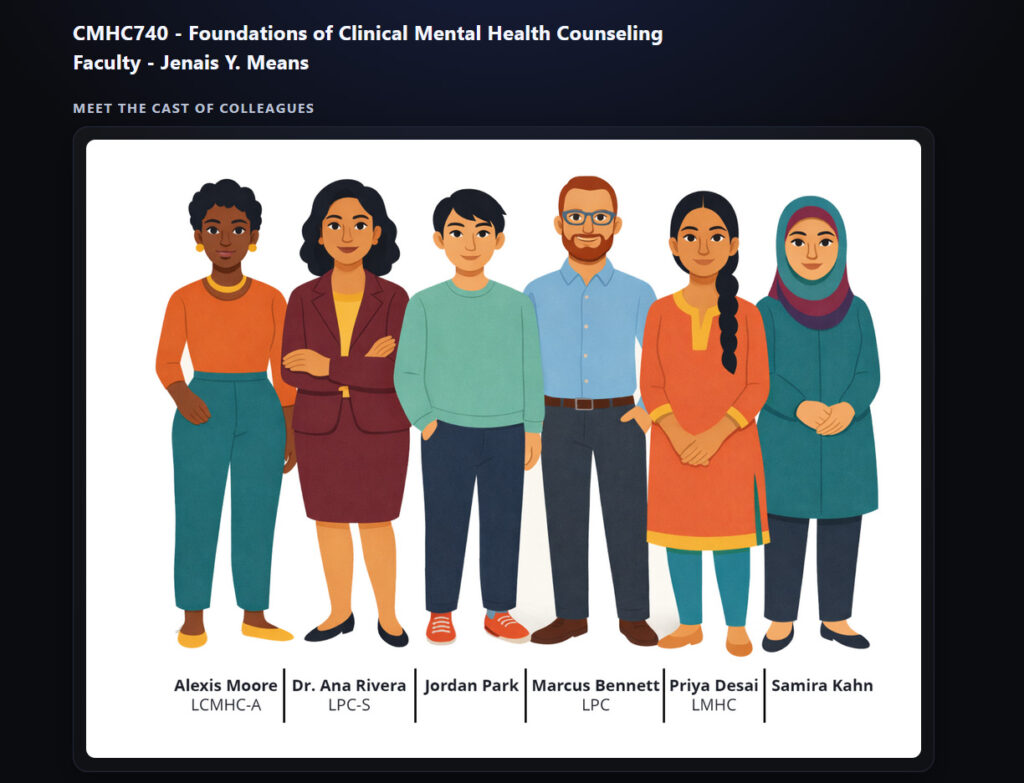
See the characters and components from this piece on the Media website.
Why It Matters
When learners can see themselves in the material, connect emotionally to examples, or follow a character’s journey, the content is far more likely to stick. As technology and pedagogy change, our oldest instructional strategy—storytelling—remains a powerful teaching tool.