Finding Open Educational Resources (OERs)
Introduction
Open educational resources (OERs) include everything from textbooks to videos, infographics, online games, and other resources. They are free, openly licensed materials available for you to use with proper credit to the original creator or copyright holder. Many OERs are created and peer-reviewed by educators and published through trusted platforms, including universities. With more high-quality options available than ever, you have the opportunity to select credible, well-produced resources at no cost to your students.
A Closer Look
Textbooks
High-quality OER textbooks are widely available in a variety of fields. Here are three popular sites that either curate (LibreTexts and Open Textbooks) or publish (OpenStax) open-access textbooks:
- LibreTexts – A nonprofit organization, LibreTexts houses over 3,000 curated open-access textbooks mostly in foundational subjects in the humanities, business, and STEM.
- OpenStax – OpenStax is a nonprofit organization based at Rice University (Houston, Texas) that publishes peer-reviewed, openly licensed college textbooks in business, STEM, computer science, nursing, and more.
- Open Textbooks from OER Commons – OER Commons is a public digital library of various OERs, including textbooks. It is run by the global nonprofit Institute for the Study of Knowledge Management in Education (ISKME). Using OER Commons, you can customize your search for open textbooks and other materials by subject matter and student level (i.e., undergraduate, professional, etc.).
These sites contain thousands of open textbooks in a variety of subject matters and are ideal for introductory courses where the foundational knowledge changes little over time. You can also supplement such textbooks with other sources, such as journal articles, government-sponsored reports, or other open resources that fill a gap in the original text.
Scholarly Journals & Articles
In addition to academic search engines like Google Scholar and JSTOR, which you’ve likely used before, here are some additional free databases to curate open-access scholarly literature: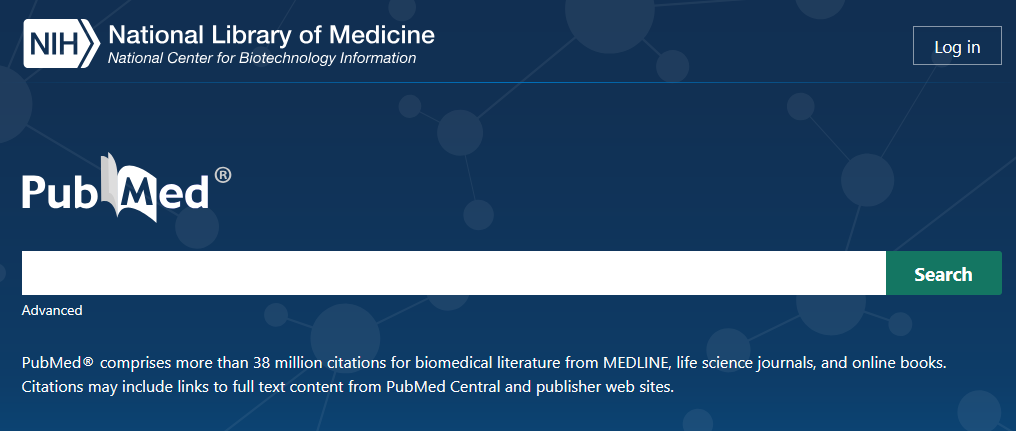
- Directory of Open Access Journals – This directory links you to trusted open-access journals and articles in various fields. There is a simple search function on the main page. The DOAJ also partners with numerous scholarly organizations, including COPE (Committee on Publication Ethics) and Crossref.
- Consensus – This is an AI-powered search engine for research articles. You can prompt the search engine with your research question and ask it to filter results by open-access publications.
- PubMed – Use PubMed to find open-access peer-reviewed literature in medicine or biological sciences. Additionally, if a paper has been funded in full or in part by federal agencies (such as the NIH), the article is freely available to you.
Images & Other Media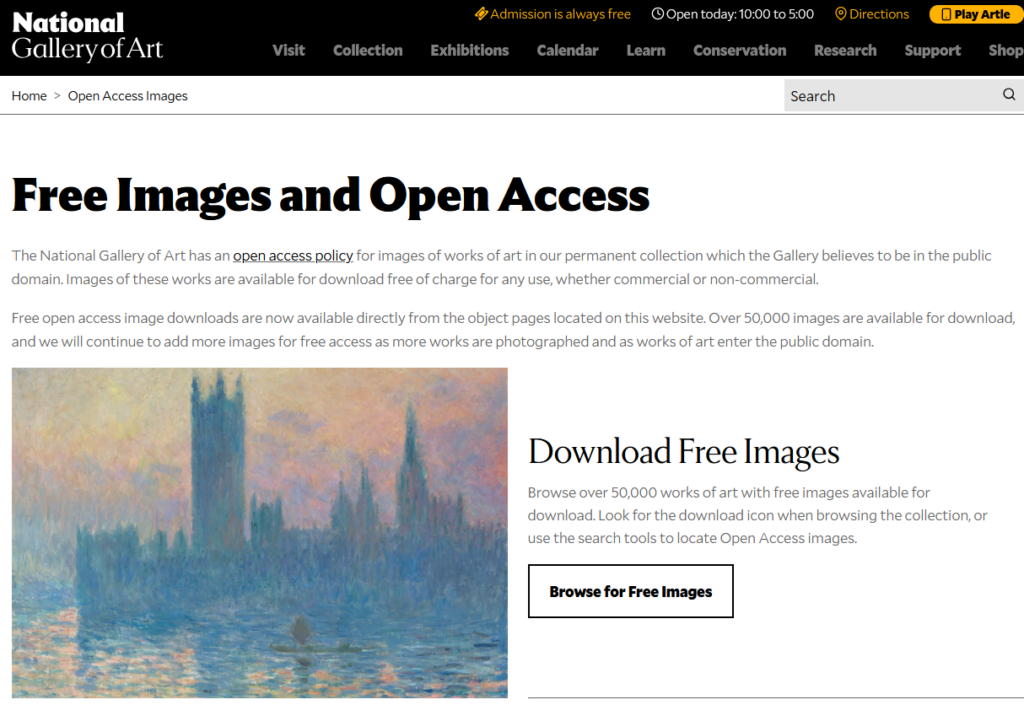
Sometimes it can be difficult to find high-quality, open-access illustrations, photographs, and other media to supplement an assignment or add some visual appeal to a lesson introduction or course overview. These resources are good places to look:
- Library of Congress – Many collections from the Library of Congress are available for educational and research purposes. Additionally, many items are in the public domain. Conveniently, details on rights and access, as well as citations in various styles (e.g., APA, MLA, etc.), are available for each item.
- National Gallery of Art Open Access Images – There are over 50,000 images from the collections of the National Gallery of Art available for download. These images are open access and in the public domain.
- Wikimedia Commons – Similar to Wikipedia, Wikimedia Commons is a database of millions of freely usable media files, including images, sounds, and videos, contributed by users.
Proper Attribution & Creative Commons Licensing
OERs are designed to be freely usable by the public, but make sure to check the Creative Commons license included with the work and attribute the work properly in your course or other resources. This includes providing a full reference with the original author, title of the work, year of publication, publisher, any other pertinent information, and a link to the CC license under which the work is licensed. Check out the Copyright and Fair Use Tip Sheet if you have questions about how to properly attribute a work.

AI-Generated Resources
With popular AI tools like ChatGPT, Adobe Firefly, and others, you have countless opportunities to generate your own resources using AI. If you go this route, make sure to double-check the accuracy of your output and consider including a reference with your creation. APA recommends treating the output of ChatGPT and similar tools as an algorithm’s output, crediting the author of the algorithm (e.g., OpenAI), the tool (e.g., ChatGPT), and the date. As a learning opportunity in using AI, you might even share your process, chat logs, and prompts with your class.
Additionally, it’s important to know that work largely generated by AI (with little human effort) cannot be copyrighted. This guidance, however, is still in progress, so remember to check your institution’s AI policy regularly and stay up-to-date with news from the U.S. Copyright Office.