
Inquiry-Based Learning
Introduction
Inquiry-based learning (IBL) is a teaching approach where students actively investigate questions or problems, gather and analyze information, and construct their own understanding rather than simply receiving knowledge. In an online course with multiple modules, IBL can be implemented in individual assignments, as ongoing projects across modules, or a combination of both.
A Closer Look
How Inquiry-Based Learning Works
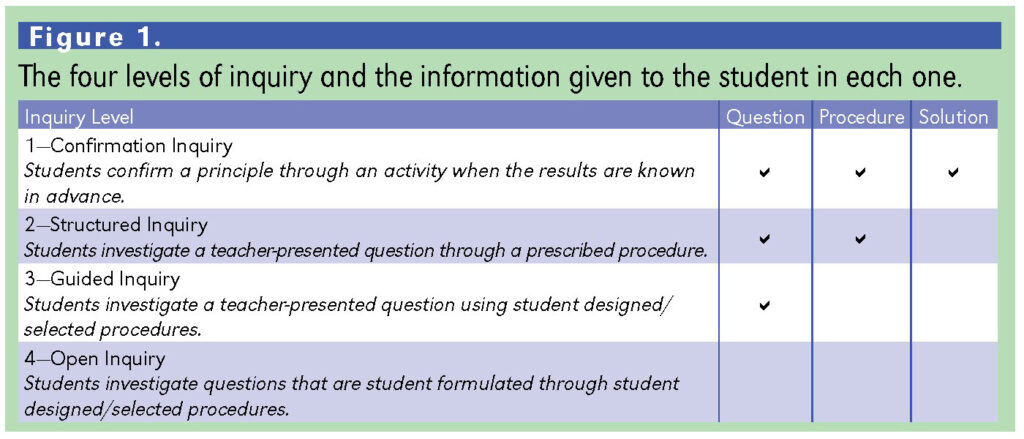
IBL is often described in four levels that help instructors design assignments and assessments according to students’ experience and learning goals:
- Students follow step-by-step instructions to confirm known outcomes.
- Assignment Example: Students simulate a standard fermentation experiment using a virtual lab platform to confirm expected bacterial growth patterns.
- Assessment: Students are graded on the accuracy of following procedures and correctly interpreting expected results.
- Students receive a guiding question and framework, but the results are unknown.
- Assignment Example: Students analyze the effect of different nutrient conditions on microbial growth using provided datasets or virtual lab simulations.
- Assessment: Students are graded on their ability to follow the procedure, analyze data, and draw conclusions.
- Students design the methodology themselves to answer a question provided by the instructor, who offers guidance and feedback.
- Assignment Example: Students test how different natural preservatives affect the shelf life of yogurt in a virtual lab, deciding on methods, controls, and data analysis.
- Assessment: Students are graded on experimental design, data collection, analysis, and interpretation, with a peer or instructor review component.
- Students choose their own topic and research question, determine their methodology, conduct their own research, and present their findings.
- Assignment Example: Students investigate how a specific enzyme affects fermentation rates for a new bioprocess and create a presentation or report detailing their methods and results.
- Assessment: Students are graded on originality, rigor of methodology, quality of analysis, and clarity of presentation.
Where to Use Inquiry-Based Learning in Your Course
- Across Modules: Start with Level 1 or 2 tasks in early modules to build foundational skills, then move to Level 3 or 4 in later modules for more complex projects.
- Single Assignments vs. Long Projects: IBL works for both. A single module assignment might be a small structured inquiry, while a semester-long project could be an open inquiry spanning multiple modules.
- Assessment Design: Consider both content knowledge and process skills (research, analysis, synthesis, communication). Use detailed rubrics to help guide your students through each level of inquiry.

Important Considerations
- Instructor Commitment: IBL requires more interaction than traditional assignments. Feedback, guidance, and resources must be scaffolded throughout the course to help students work through each level of inquiry.
- Assessment Complexity: Beyond content mastery, students develop research, analytical, and problem-solving skills that can be challenging to assess. Clear and detailed rubrics are essential.
- Time and Planning Requirements: Level 4 projects demand substantial time for defining questions, designing methods, conducting research, and presenting results. Ensure the course schedule supports these activities.
- Long-Term Benefits: Despite these challenges, IBL nurtures curiosity, critical thinking, creativity, and self-directed learning—skills that extend far beyond a single course.
Additional Resources
- Fostering Student Questions: Strategies for Inquiry-Based Learning from Edutopia
- Why Minimal Guidance During Instruction Does Not Work: An Analysis of the Failure of Constructivist, Discovery, Problem-Based, Experiential, and Inquiry-Based Teaching by Kirschner et al. (2006)
- Where Do You Want to Go Today? Inquiry-Based Learning and Technology Integration by Owens et al. (2002)