
Instructor Presence
Introduction
The time and effort you spend invested in your course will be worth the payoff in student learning and satisfaction. According to Dunlap and Lowenthal (2009), “contact between students and faculty in and outside of class is critical for student engagement because it influences student motivation and involvement.”
A Closer Look
Like teaching in a face-to-face setting, teachers vary considerably in the methods and degrees to which they choose to develop connections with students. While it is largely a matter of style, experience and scholarship indicate that students log in more frequently and produce more high-quality work in online courses in which instructors are frequently and truly interactive. Here are some ways to be more interactive with your students:
Practice Solid Interaction
- Create an introductory/welcome video about you and your course. Our media team is happy to help you with creating videos!
- Start the course with an icebreaker discussion, and post and participate yourself.
- Post regular announcements to discuss the course content with your students.
- Personalize your communications. Address students by their first names when sending an email or feedback on assignments.
- Respond promptly to questions.
- Hold weekly office hours via chat, telephone, or web conference.
- Check in every day (or nearly so).
- Offer timely and detailed feedback on all student work.
Achieve Even Greater Interaction
- Participate in student discussion forums on occasion.
- Use the announcements feature as a course blog. Include personal anecdotes or professional experience relevant to the course, or connect the course content to broader issues in your industry or the news. You might also direct students to a blog you keep outside of Canvas.
- Create discussion forums in which you ask questions and encourage students to ask questions as well.
- Include audio or podcasts that you recorded yourself as an alternative to written content. You can also record your feedback on student work.
- Don’t wait until the end of the course to find out what students think of the assignments or activities. Use the ungraded quizzes feature in Canvas to collect student feedback throughout the course.
Approach the Gold Standard of Interaction
- Require each student (or groups of students) to have a short web conference with you during the first two weeks of class.
- Provide students with tips on how to motivate themselves—and solicit tips from them as well.
- Include graphics, videos, and other media to enhance your written content. You might also include media in the announcements you post or in your student feedback. Consider using photographs or videos that you have created yourself, which can be especially meaningful if they are of excellent quality.
- Require students to assess themselves as a part of major assignments—and offer feedback on the self-assessment and the assessment itself. Your instructional designer can be a great resource on ways to integrate self-assessments into your course!
- Use social media platforms like LinkedIn to facilitate student interactions and connect to broader themes in your course. This moves beyond “the structure of an LMS or the timing of a semester” (Dunlap & Lowenthal, 2009).
- Mentor students by suggesting areas for more research, internships, and job opportunities.
- Engage in discussions with other online instructors and get their best tips for interacting with students.

Announcement Example
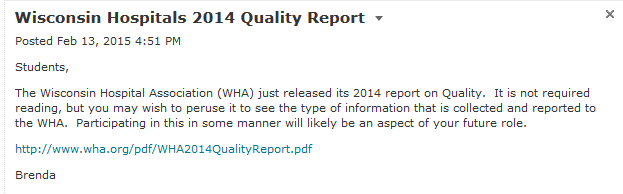
Here is an announcement from a course. Notice how it connects students to broader industry awareness and encourages them to think about their professional future.
Additional Resources
- Exploring online teaching: A three-year composite journal of concerns and strategies from online instructors by Lin et al. (2012) in the Online Journal of Distance Learning Administration
- Online graduate students’ perceptions of best learning experiences by Holzweiss et al. (2014) in Distance Education
- Social interaction in self-paced distance education by Anderson et al. (2015) in Open Praxis
- Students’ perceptions of online learning and instructional tools: A qualitative study of undergraduate students use of online tools by D.A. Armstrong (2011) in the Turkish Online Journal of Educational Technology
Reference
- Dunlap, J. C., & Lowenthal, P. R. (2009). Tweeting the night away: Using Twitter to enhance social presence. Journal of Information Systems Education, 20(2), 129-135.