
Lecture Alternatives
Introduction
Spoken recorded lectures have long been—and will continue to be—an essential part of higher education, valued both for explaining complex ideas and because students expect them in online curricula. However, research highlights two key limitations: learners often overestimate how much they retain from listening alone, and lectures by themselves do not naturally foster metacognition or critical thinking, which are crucial for academic success. This doesn’t mean instructors should eliminate lectures, but rather that they can be redesigned for online contexts and combined with strategies that enhance retention and critical thinking.
A Closer Look
You can streamline lecture content and encourage critical thinking in several ways. Here are three effective strategies:
1. Present Your Lecture in a Different Way
- “Microlearning” Videos: Many online instructors will break up a long lecture into multiple parts, focusing on just one main concept per lecture. This avoids cognitive overload and simplifies instructor updates when needed.
- Multimedia and Interactive Elements: Studies show students retain learning more when detailed audio is presented alongside relevant visuals. Narrated PowerPoints can be used for this purpose. You can also include interactive elements that allow students to learn material by interacting with a course concept, such as the interactive timeline created with H5P shown here.
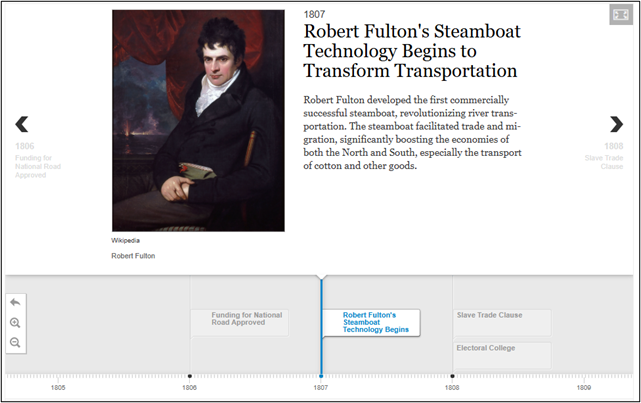
Interactive timeline created with H5P Figure 1.
- Annotated Readings and Video Walkthroughs: Consider balancing reading texts with videos for content delivery. Many online textbooks allow students to digitally annotate readings individually or in groups. Instructors can model this active interaction with course content through video walkthroughs, as in this music course example and assessment walkthrough.
2. Incorporate Active Learning Strategies Alongside Content
- Low-Stakes Knowledge Checks and Reflections: Providing students with frequent opportunities to interact with and practice their learning as they consume content improves active learning and retention. For example, you could introduce a topic with a brief lecture, followed by a low-stakes practice activity (see this interactive science practice example and this topic selection example). There are several free online tools to create interactive elements. One is H5P, which allows you to embed interactive knowledge checks and practice during or immediately after students read or view course content. Study guides that accompany course content are lower-tech options as well.
- Case Studies and Scenarios: Using case studies and scenarios is a powerful way to ensure student engagement and retention. Providing students with real-world scenarios or case studies allows them to apply course concepts either within or alongside your lectures. Here are some excellent examples of assignments that use case studies and scenarios.
- Simulations and Role Playing (with AI): Role playing is another active learning strategy. It allows students to place themselves directly in a situation that requires them to practice the course’s learned skills. Simulations can take the form of peer practice, as in this meeting simulation example. Role-playing can utilize peer interaction, as in this bioremediation role-play example, or could leverage technology, as in this role-playing with AI example.
3. Use Peer Engagement Techniques
- Peer Teaching: Peer learning activities such as fishbowl, Socratic, and jigsaw discussions, as well as Oxford-style debates, are all adaptable to online discussion boards. They use the power of the group so that students can teach and learn from each other, ultimately fostering a deeper and more active way of learning course concepts and skills.
- Collaborative Projects: Group projects have similar learning benefits. Almost any activity can have a collaborative component wherein peers learn and work together to create a product that demonstrates their knowledge. Care should be taken to choose collaborative projects with intention and plan them to maximize group dynamics and productivity. See the Group Work Tip Sheet for more details if you would like to plan collaborative projects.
Additional Resources
- Overcoming Overconfidence in Learning from Video-Recorded Lectures: Implications of Interpolated Testing for Online Education by Szpunar et al. (2014)
- Rethinking the Fishbowl Discussion Strategy: A Mechanism to Construct Meaning and Foster Critical Thinking and Communication Skills Through Student Dialogue by Cummings (2015)
- Self-Regulated Learning Strategies & Academic Achievement in Online Higher Education Learning Environments: A Systematic Review by Broadbent and Poon (2015)