
Multiple-Choice Questions
Introduction
Multiple-choice questions are widely used in online courses because they are flexible, efficient, and easy to grade, especially with auto-grading tools built into most learning management systems. They can also be highly reliable: in general, the more questions included on a test, the more dependable the results. For example, on a 25-question test, the odds of a student scoring 70% by guessing alone are extremely low (about 1 in 942,651).
However, these advantages depend on the quality of the questions. Poorly written multiple-choice questions can confuse learners and reduce the validity of the assessment. On the other hand, well-written questions accurately measure whether students have achieved the intended learning objectives. To write effective multiple-choice questions, focus on presenting a clear problem in the stem and providing plausible, well-constructed answer choices.
A Closer Look
The Parts of a Multiple-Choice Question
Breaking down the components of a multiple-choice question can help you construct stronger assessments.
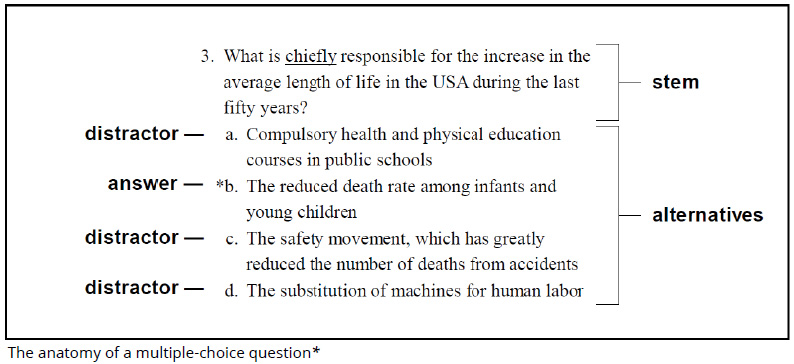
- The stem should be meaningful and present a clear problem.
- The answer choices (i.e., alternatives) should be plausible, stated clearly, and free of clues that hint at the correct answer.
Checklist for Reviewing Multiple-Choice Questions
Use the checklist below to evaluate the quality of your multiple-choice questions before including them in an assessment:
- Does the question assess learners’ understanding of key terms and concepts that align with the learning objective(s)?
- Are the question and all answer choices stated clearly and concisely?
- Are all answer choices plausible?
- Is there one (and only one) correct or clearly best answer?
- Are correct answers distributed randomly among the answer choices?
Example Question
Learning Objective: Learners will create an effective, asynchronous online course.
To design an effective course, learners must understand key components of the course development process. The example below illustrates how question quality can impact assessment validity.

Why avoid “All of the above” and “None of the above”?
Both of these options can make questions easier to guess without fully understanding the material. For example, if a student recognizes that two options are correct, they can often choose “All of the above” without evaluating the remaining choices. This means the question may measure test-taking strategy rather than actual learning.
⭐ Tip: Instead of using “All of the above” or “None of the above,” try writing three strong answer choices. Research shows that three well-written options are usually enough to assess understanding effectively, while also saving time for both test-takers and instructors.
Additional Resources
- 10 Rules for Writing Multiple-Choice Questions by the eLearning Coach
- A Refresh on Writing Quality Multiple Choice Questions by the University of Michigan
- Writing Good Multiple-Choice Test Questions by Vanderbilt University