
Storytelling
Introduction
Storytelling is central to how we learn and understand the world. From an early age, we use narratives to make sense of our surroundings, build connections, and develop empathy. Stories also help us grasp complex or abstract concepts. In an online learning environment, storytelling can be an effective tool not only to teach but also to foster a sense of connection between you and your students, as well as among the students themselves. This sense of camaraderie can enhance student engagement, retention, and overall learning.
Here are some places to incorporate storytelling into your online course:
- As an icebreaker at the start of the course
- To introduce units or lessons
- In announcements sharing relevant news articles or course updates
- Before or during narrated lectures
- To guide and enrich discussions
- As part of single-lesson discussions and assignments
- As part of more complex, semester-long projects
A Closer Look
Planning Your Story
For adult learners in online courses, scenarios are often used to engage students and place them in real-world contexts where they can apply course knowledge and develop practical skills. If you plan to use a story—also known as a case study or scenario—as the focal point for a lesson, activity, or even the entire course, careful planning is essential. Poorly developed stories that feel unrealistic, superficial, or cliché can have the opposite effect and distract or frustrate students.
The most effective stories follow a familiar narrative arc:
- Exposition: Establish the background of the story, including its setting and context, and introduce the main characters. Give only your main characters a name, and keep their personas consistent throughout the course.
- Rising Action: Present the challenges the main character will face or the journey they will take toward the climax (or resolution) of the story.
- Climax: Put your character in a position where they will need to act or change at the highest moment of your building narrative. In the context of a course, perhaps you’ve put your students in a scenario where they’ve been asked to complete a series of small activities building toward a major assignment (such as a long research paper, presentation, or other culminating activity).
- Falling Action: Start to resolve the narrative for your main character. Have your character reflect on the purpose of their journey and make a plan that will lead them to the main conclusion or outcome of the story—that is, where they have been, who or what’s helped them along the way, and what they’ve learned or still need to learn.
- Resolution: Having gained some wisdom along the journey, the main character shares their insights on the journey, concludes their story, and moves on to the next one. In a course, this could look like a final reflective essay or discussion on the culminating course assignment.
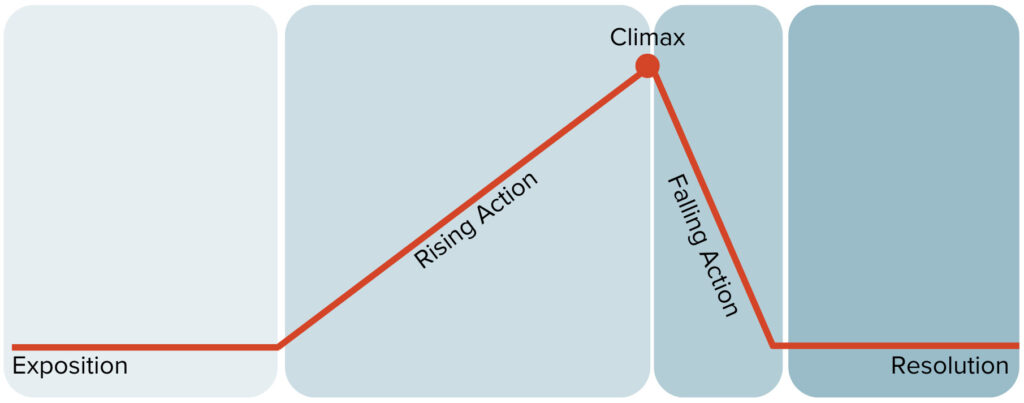
- The five-stage narrative arc—exposition, rising action, climax, falling action, and resolution—illustrating the structure of tension and release common to most dramatic storytelling
Writing Your Story
To create a compelling story, consider the following:
- Put the student at the center of the narrative. Tell your student what character they’ll play, then try writing in the second person, positioning the student as the main character who navigates the scenario.
- Ground the story in reality, but be creative. Draw on experiences from your field or career to create an authentic setting, characters, tasks, and other details.
- Challenge your main character. Build a sequence of tasks or decisions that lead the main character toward a climactic final project or assignment. Give them a sense of accomplishment at the end. For instance, a scenario that unfolds across multiple lessons could gradually build complexity, culminating in a major project, followed by a reflective assignment or class discussion as the falling action.
- Keep track of the details and ask for feedback. Maintain a separate document to track character names, settings, tasks, and other important elements. This ensures consistency and helps you manage the story effectively over time. Additionally, at the end of the course, ask how the students liked the storytelling element of the class and what they would change or build on.
- Use an AI tool to help you with the original drafting phrase. Using AI can be helpful for brainstorming or writing the initial draft of your story or scenario. However, AI output can often be superficial or vague. Remember to add complexity and authenticity to your draft informed by your knowledge! You might add specific details regarding your field or area of study, your own relevant personal experience, or more complexity to the characters and setting.

More Storytelling Tips & Tools
- Tell a story that is true, fictitious, or a blend of both. Be creative!
- Incorporate media using simple tools like PowerPoint, Canva, or your smartphone to create graphics or record video or audio.
- Have fun but stay focused! Remember to keep your story engaging and connected to your learning objectives.
- Reach out to your instructional designer for help. They can help you plan your story, create media elements, and put your story into your course.
Additional Resources
- The Power of Storytelling: Using Narrative to Enhance Teaching and Learning from the University of Alabama
- Story-Based Learning Live Course Examples on the OPLR Instructional Strategies & Course Design Showcase
- Storytelling in Teaching from the Association for Psychological Science
- What Makes Storytelling So Effective for Learning? from Harvard Business Impact