
Practice Assessments
Introduction
Educational research consistently shows that students experience lower test anxiety and perform better on graded assessments when they complete practice assessments first. These low-stakes exercises help students engage with the material, identify gaps in their understanding, and reinforce key concepts. When designed thoughtfully, practice assessments can transform high-pressure assignments into opportunities for ongoing learning and reflection.
A Closer Look
Practice assessments are most effective when they are carefully aligned with instructional goals. The sections below detail the key characteristics of practice assessments and methods for implementing them effectively.
Key Features of Effective Practice Assessments
The most effective practice assessments:
- Mirror the format and content of graded assessments
- Clearly specify which learning objectives they cover
- Provide feedback on both correct and incorrect responses
- Encourage students to analyze why an answer is correct or incorrect rather than merely memorizing answers
Practice Assessment Methods
Practice assessments can take several forms depending on your instructional goals. The table below provides an overview of each method, including a suggested type of practice assessment and tips for its design.
Explanatory Feedback
This method is where students receive hints and detailed guidance on each question to help them understand concepts and learn from mistakes as they progress.
- Help students learn new content, building from simpler to complex concepts
- Practice quiz with feedback through hints on each question
- Control how many questions students can see at once so they must process feedback from one question before moving to the next.
- Mention learning resources where appropriate, such as articles or chapter numbers.
Drill
This method uses repeated practice, often with automatically graded questions, to help students memorize terms, formulas, or procedures.
- Help students memorize terms, formulas, or procedures
- Automatically graded multiple-choice or fill-in-the-blank quizzes that provide instant feedback as to whether the answer is right or wrong
- Break large amounts of content into smaller quizzes of 10 to 20 questions.
- Vary how terms, formulas, or procedures are presented (e.g., multiple-choice, fill-in-the-blank, matching) to strengthen recall and help students apply knowledge in different situations.
Readiness Check
This method lets students assess their preparedness for an upcoming graded assessment by completing a quiz and reviewing which areas need further study.
- Help students assess readiness for formative or summative graded assessments
- Automatically graded quiz with feedback only provided after submission
- Focus on objective questions (true/false, multiple-choice, fill-in-the-blank) that can be automatically graded.
- Draw questions from the same question bank as the graded assessment.
- Reveal only which questions were incorrect, not the correct answers, to encourage further study.
Examples
Scenario 1: Explanatory Feedback Method
In an American history course, the instructor used small writing exercises to help students meet goals such as identifying time periods and citing supporting evidence. Students also completed practice questions on various topics, such as the one below, and received tailored feedback regardless of their answer to help them check their reasoning and strengthen their understanding of the content.

Scenario 2: Readiness Check Method
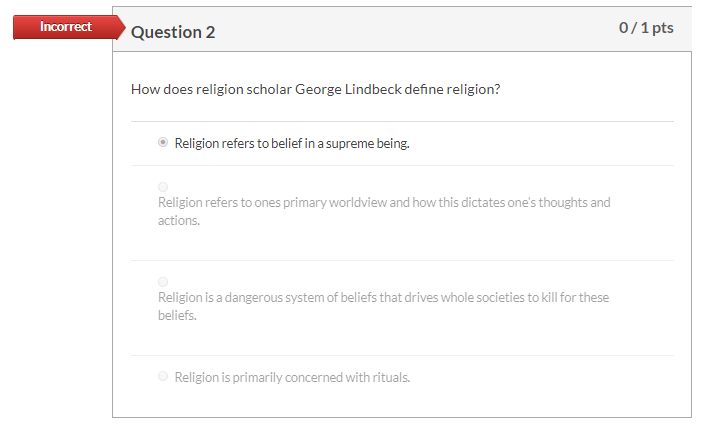
A world religions course included readiness-check quizzes to help students gauge their preparedness for the graded exams. Practice questions were drawn from the same question bank as the graded assessments. After submission, students saw which questions they answered incorrectly but did not see the correct answers, prompting further research. Students could retake the quiz after reviewing the course content to find the correct responses.

Quick Ways to Incorporate Practice Assessments
Here are some quick ways to incorporate practice assessments into your course:
- Before major assessments: Offer low-stakes quizzes one or two weeks before a midterm or final.
- After introducing challenging concepts: Reinforce understanding through short practice exercises.
- During skill-building activities: Use drills or feedback exercises alongside labs, problem sets, or writing assignments.
- At module or unit checkpoints: Include readiness-check quizzes to help students identify areas needing review.
- For cumulative review: Combine prior topics into practice assessments to strengthen long-term retention and integrate learning across modules.
Additional Resources
- Feedback Enhances the Positive Effects and Reduces the Negative Effects of Multiple-Choice Testing by Butler and Roediger (2008)
- Improving Students’ Learning with Effective Learning Techniques: Promising Directions from Cognitive and Educational Psychology by Dunlosky et al. (2013)
- Practice Tests as Formative Assessment Improve Student Performance on Computer-Managed Learning Assessments by Sly (1999)