
Providing Evolving Ideas on AI and Creative Writing
Overview
Students are given the instructor’s perspective on using AI in a creative writing course, detailing when these tools may be beneficial (or not) to learning and creativity.
Why Use This?
Students are presented with the instructor’s ideas for how to use AI to reimagine or supplement their own creative work. This gives them practice using these tools and insight into how individuals in creative fields might be using them already. Additionally, by sharing her perspective on AI, the instructor acknowledges her own learning curve using these tools, building camaraderie with students.
How Does It Work?
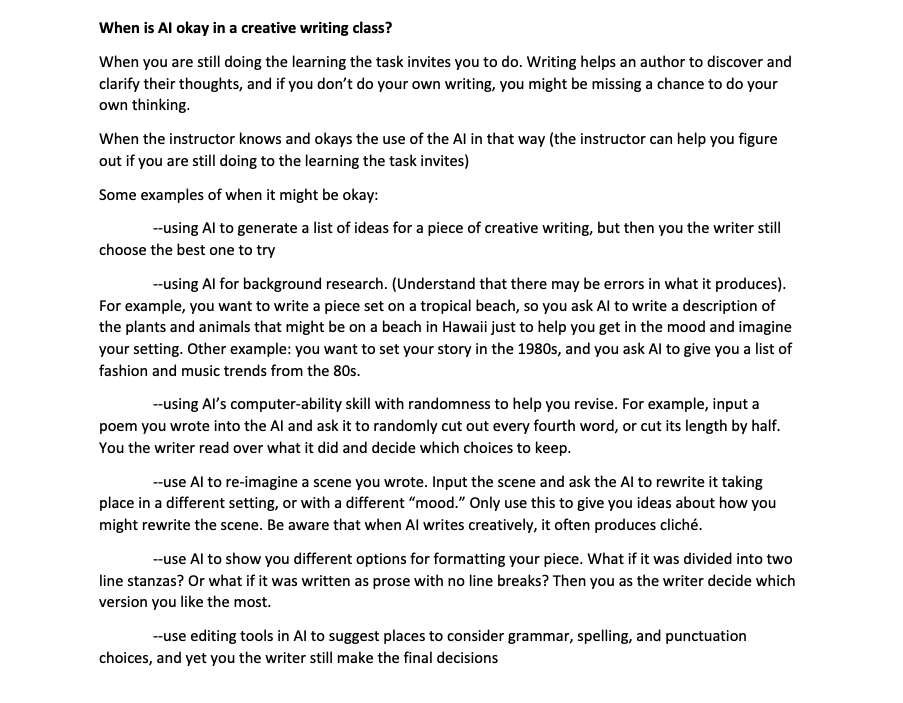
In the introductory module of the course, the following document is provided to students as both a writing resource and policy regarding AI:-
Open accessible text version of previous image
When is AI okay in a creative writing class?
When you are still doing the learning the task invites you to do. Writing helps an author to discover and clarify their thoughts, and if you don’t do your own writing, you might be missing a chance to do your own thinking.
When the instructor knows and okays the use of the AI in that way (the instructor can help you figure out if you are still doing the learning the task invites)
Some examples of when it might be okay:
- using AI to generate a list of ideas for a piece of creative writing, but then you the writer still choose the best one to try
- using AI for background research. (Understand that there may be errors in what it produces). For example, you want to write a piece set on a tropical beach, so you ask AI to write a description of the plants and animals that might be on a beach in Hawaii just to help you get in the mood and imagine your setting. Other example: you want to set your story in the 1980s, and you ask AI to give you a list of fashion and music trends from the 80s.
- using AI’s computer-ability skill with randomness to help you revise. For example, input a poem you wrote into the AI and ask it to randomly cut out every fourth word, or cut its length by half. You the writer read over what it did and decide which choices to keep.
- use AI to re-imagine a scene you wrote. Input the scene and ask the AI to rewrite it taking place in a different setting, or with a different “mood.” Only use this to give you ideas about how you might rewrite the scene. Be aware that when AI writes creatively, it often produces cliché.
- use AI to show you different options for formatting your piece. What if it was divided into two line stanzas? Or what if it was written as prose with no line breaks? Then you as the writer decide which version you like the most.
- use editing tools in AI to suggest places to consider grammar, spelling, and punctuation choices, and yet you the writer still make the final decisions
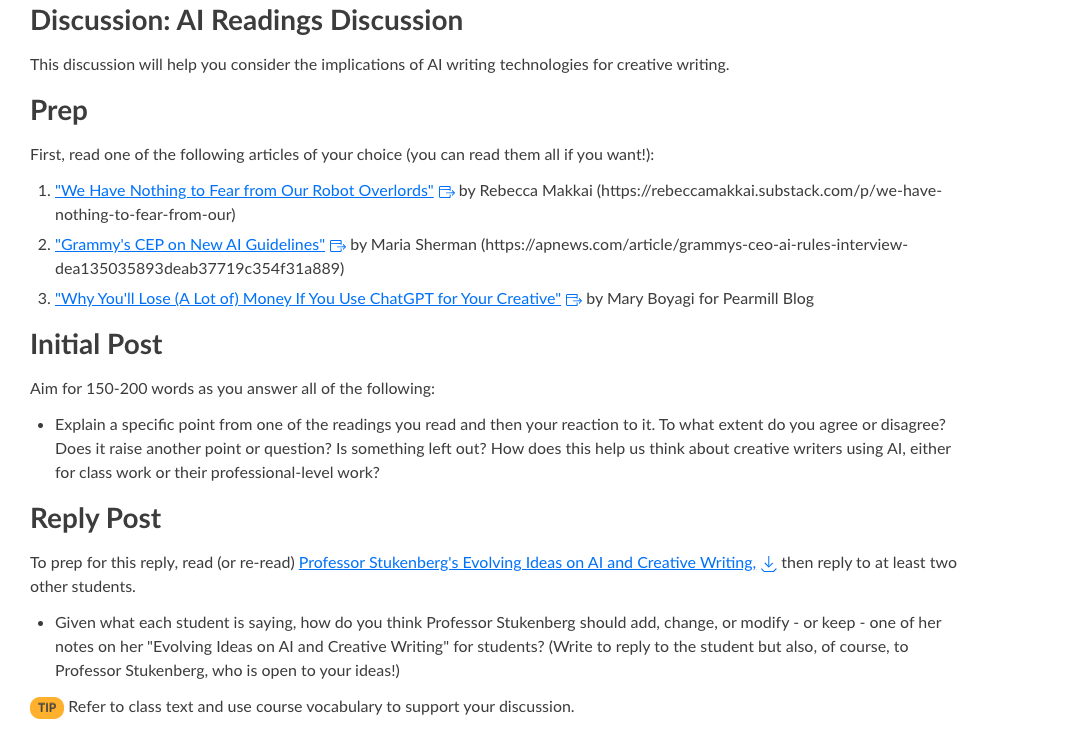
The instructor then directs students to use the document to complete one discussion assignment, which follows:
Open accessible text version of previous image
Discussion: AI Readings Discussion
This discussion will help you consider the implications of AI writing technologies for creative writing.
Prep
First, read one of the following articles of your choice (you can read them all if you want!):
- “We Have Nothing to Fear from Our Robot Overlords” by Rebecca Makkai
- “Grammy’s CEO on New AI Guidelines” by Maria Sherman
- “Why You’ll Lose (A Lot of) Money If You Use ChatGPT for Your Creative” by Mary Boyagi for Pearmill Blog
Initial Post
Aim for 150-200 words as you answer all of the following:
- Explain a specific point from one of the readings you read and then your reaction to it. To what extent do you agree or disagree? Does it raise another point or question? Is something left out? How does this help us think about creative writers using AI, either for class work or their professional-level work?
Reply Post
To prep for this reply, read (or re-read) Professor Stukenberg’s Evolving Ideas on AI and Creative Writing, then reply to at least two other students.
- Given what each student is saying, how do you think Professor Stukenberg should add, change, or modify – or keep – one of her notes on her “Evolving Ideas on AI and Creative Writing” for students? (Write to reply to the student but also, of course, to Professor Stukenberg, who is open to your ideas!)
Tip: Refer to class text and use course vocabulary to support your discussion.
Keep In Mind
Because AI is changing rapidly, if you decide to include a similar document or page in your course, you’ll need to review and update it regularly.