
Designing Workplace Chat Simulations for Course Discussions
Overview
Students analyze realistic chat conversations between coworkers discussing whether their organization should take a public stance on a complex issue.
Why Use This?
This approach makes a traditional discussion assignment more engaging by presenting it as a workplace-style conversation. The chat format gives students a clear situation to respond to, rather than a single prompt, and helps them see how their ideas connect to others’ viewpoints in the discussion.
Additionally, the scenario continues over the semester, helping students make deeper connections with the course content and practice real-world advocacy skills in a low-stakes setting that reflects the communication methods they’ll use in their careers.
⭐ What Students Say
Students engaged actively with the activity and responded positively to the scenario-building approach. Many demonstrated a solid understanding of how to tailor messaging to different audiences and contexts.
How Does It Work?
AI was used to create Canvas-friendly, accessible template that displays chat-based messaging conversations between scenario coworkers, which looks similar to a workplace chat application. These chats were then integrated into weekly discussion prompts.They are html files which can be easilly edited as needed.
Each scenario presents a focused issue along with multiple perspectives for students to analyze. The sequence of discussions builds a cohesive narrative that supports ongoing engagement and reinforces key concepts over time.
Review the activity components by clicking on the tabs:
Open accessible text version of previous image
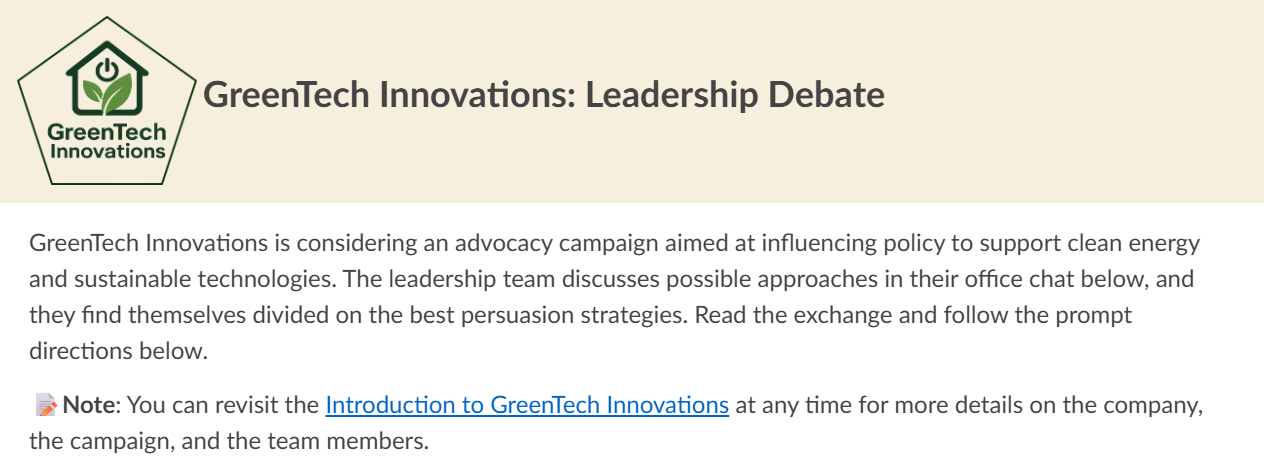
GreenTech Innovations is considering an advocacy campaign aimed at influencing policy to support clean energy and sustainable technologies. The leadership team discusses possible approaches in their office chat below, and they find themselves divided on the best persuasion strategies. Read the exchange and follow the prompt directions below.
📝Note: You can revisit the Introduction to GreenTech Innovations at any time for more details on the company, the campaign, and the team members.
Open accessible text version of previous image
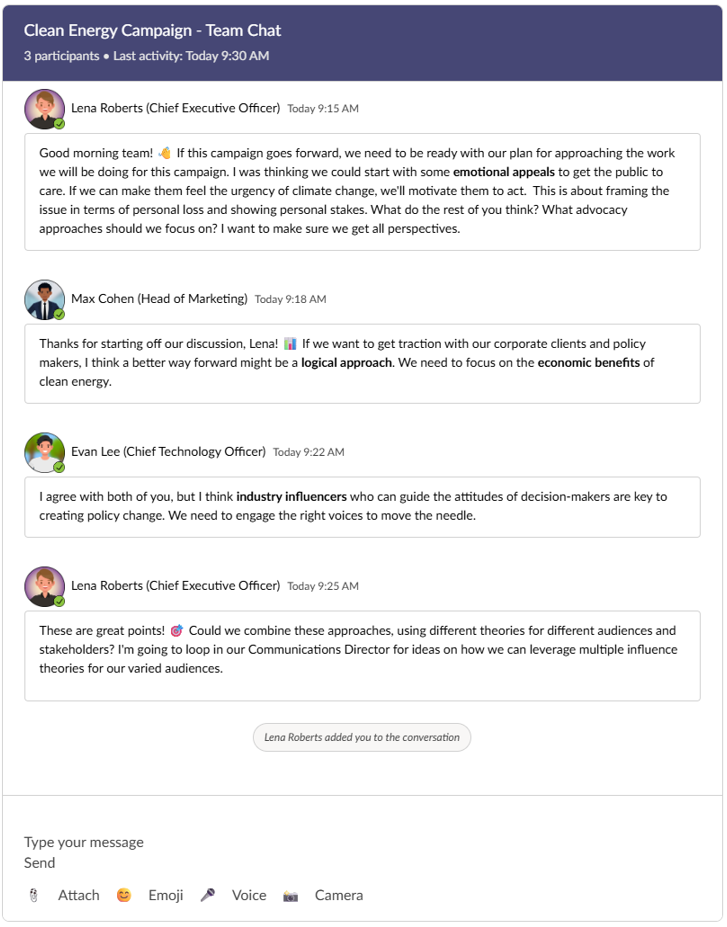
Clean Energy Campaign – Team Chat
3 participants • Last activity: Today 9:30 AM
Lena Roberts (Chief Executive Officer)
Today 9:15 AM
Good morning team! 👋 If this campaign goes forward, we need to be ready with our plan for approaching the work we will be doing for this campaign. I was thinking we could start with some emotional appeals to get the public to care. If we can make them feel the urgency of climate change, we’ll motivate them to act. This is about framing the issue in terms of personal loss and showing personal stakes. What do the rest of you think? What advocacy approaches should we focus on? I want to make sure we get all perspectives.
Max Cohen (Head of Marketing)
Today 9:18 AM
Thanks for starting off our discussion, Lena! 📊 If we want to get traction with our corporate clients and policy makers, I think a better way forward might be a logical approach. We need to focus on the economic benefits of clean energy.
Evan Lee (Chief Technology Officer)
Today 9:22 AM
I agree with both of you, but I think industry influencers who can guide the attitudes of decision-makers are key to creating policy change. We need to engage the right voices to move the needle.
Lena Roberts (Chief Executive Officer)
Today 9:25 AM
These are great points! 🎯 Could we combine these approaches, using different theories for different audiences and stakeholders? I’m going to loop in our Communications Director for ideas on how we can leverage multiple influence theories for our varied audiences.
Lena Roberts added you to the conversation
Type your messagePress Enter to send, Shift+Enter for new line
Send
📎
Attach
😊
Emoji
🎤
Voice
📸
Camera
Open accessible text version of previous image
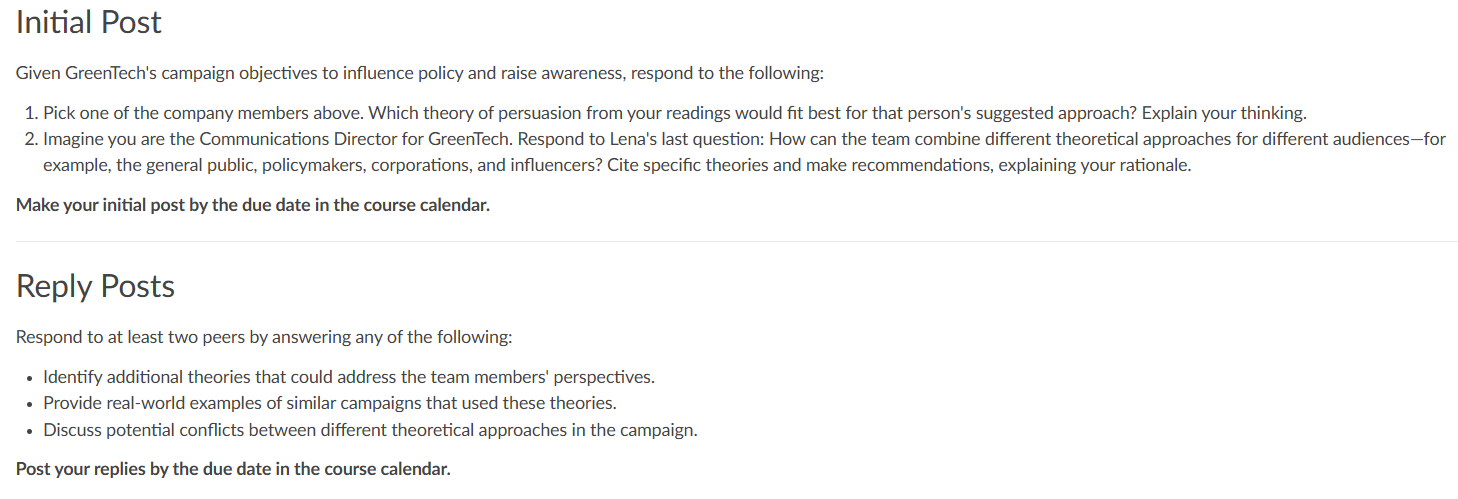
Initial Post
Given GreenTech’s campaign objectives to influence policy and raise awareness, respond to the following:
- Pick one of the company members above. Which theory of persuasion from your readings would fit best for that person’s suggested approach? Explain your thinking.
- Imagine you are the Communications Director for GreenTech. Respond to Lena’s last question: How can the team combine different theoretical approaches for different audiences—for example, the general public, policymakers, corporations, and influencers? Cite specific theories and make recommendations, explaining your rationale.
Make your initial post by the due date in the course calendar.
Reply Posts
Respond to at least two peers by answering any of the following:
- Identify additional theories that could address the team members’ perspectives.
- Provide real-world examples of similar campaigns that used these theories.
- Discuss potential conflicts between different theoretical approaches in the campaign.
Post your replies by the due date in the course calendar.
Keep In Mind
-Use real chat-based designs for inspiration, such as those in Microsoft Teams, to create your own graphics with AI.
-Include a detailed accessibility request in your AI prompt to ensure your graphics are accessible. Example: “Make sure the code you create meets ADA and WCAG 2.1 AA standards.”
-Create character personas before drafting your scenario or take notes on each character’s perspective to ensure consistency across the narrative.