
Increasing Critical Thinking via a Research-based Framework
Overview
Students engage in deeper conversations when a framework to encourage critical thinking is applied to the discussion prompts.
Why Use This?
Online discussions don’t automatically lead to critical thinking, but providing a research-based framework for these conversations can elevate them from surface-level information sharing to higher levels of knowledge construction.
How Does It Work?
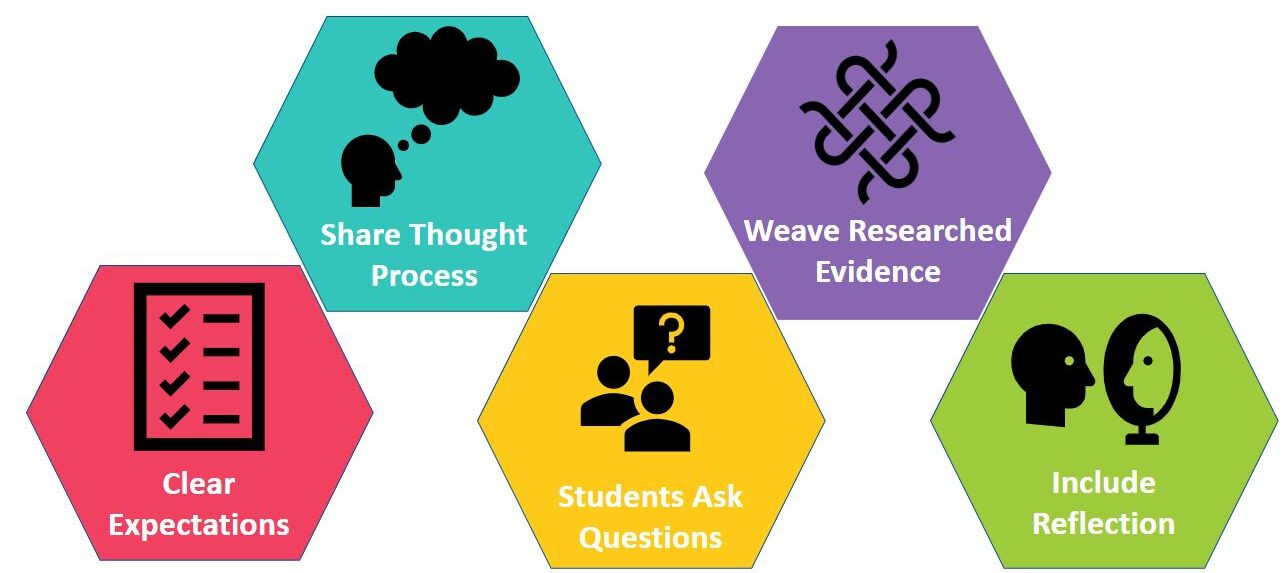
This framework, known as the Framework for Student Engagement and Critical Thinking, was the result of research conducted by two of our instructional designers at UWEX. The framework has five components to consider when creating your discussion prompts. You can select the components according to your goals for the discussion:
- Set clear expectations and provide detailed instructions, so students know how to approach the discussion assignment.
- Invite students to share their thought process for all to see, similar to a think-aloud process.
- Encourage students to ask questions to foster more discussion with their peers.
- Weave researched evidence into the body of the discussion to promote credibility.
- Ask students to include a reflection at the end of their posts to highlight new learning.
Open accessible text version of previous image
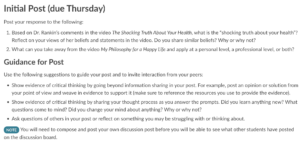
Initial Post (due Thursday)
Post your response to the following:
- Based on Dr. Rankin’s comments in the video The Shocking Truth About Your Health, what is the “shocking truth about your health”? Reflect on your views of her beliefs and statements in the video. Do you share similar beliefs? Why or why not?
- What can you take away from the video My Philosophy for a Happy Life and apply at a personal level, a professional level, or both?
Guidance for Post
Use the following suggestions to guide your post and to invite interaction from your peers:
- Show evidence of critical thinking by going beyond information sharing in your post. For example, post an opinion or solution from your point of view and weave in evidence to support it (make sure to reference the resources you use to provide the evidence).
- Show evidence of critical thinking by sharing your thought process as you answer the prompts. Did you learn anything new? What questions come to mind? Did you change your mind about anything? Why or why not?
- Ask questions of others in your post or reflect on something you may be struggling with or thinking about.
Note: You will need to compose and post your own discussion post before you will be able to see what other students have posted on the discussion board.
Keep In Mind
- Provide high-quality examples of the types of posts you’re looking for (and remember to model them yourself).
- Give your students feedback right away. Make sure to comment on the qualities of a post that demonstrate critical thinking.
- Start the course with “easier” discussion topics that focus on your students’ views or experiences.
- Use a rubric (also provided to students) to assess discussions.
Additional Resources
Effect of Role-Play in Online Discussions on Student Engagement and Critical Thinking
A Framework for Increasing Critical Thinking, Student Engagement, and Knowledge Construction in Online Discussion