
Using Media to Deepen Discussions on Leadership
Overview
Students examine the difference between IT leadership and IT management through a short instructional video and an accompanying discussion.
Why Use This?
This approach uses media to make abstract concepts more concrete, helping students understand the material and apply it during the discussion activity.
Using a short video to differentiate between IT leadership and IT management helps students visualize these abstract concepts and provides a common foundation for discussion. The discussion gives students an opportunity to reflect on what they learned, consider the differences between leadership and management, and connect these concepts to their own knowledge and experiences.
How Does It Work?
Students first watch the video, Managers vs. Leaders, which uses an interactive graphic and professional voiceover to explain the differences between IT leadership and IT management. Students then participate in a discussion where they reflect on the concepts presented in the video and engage with their peers.
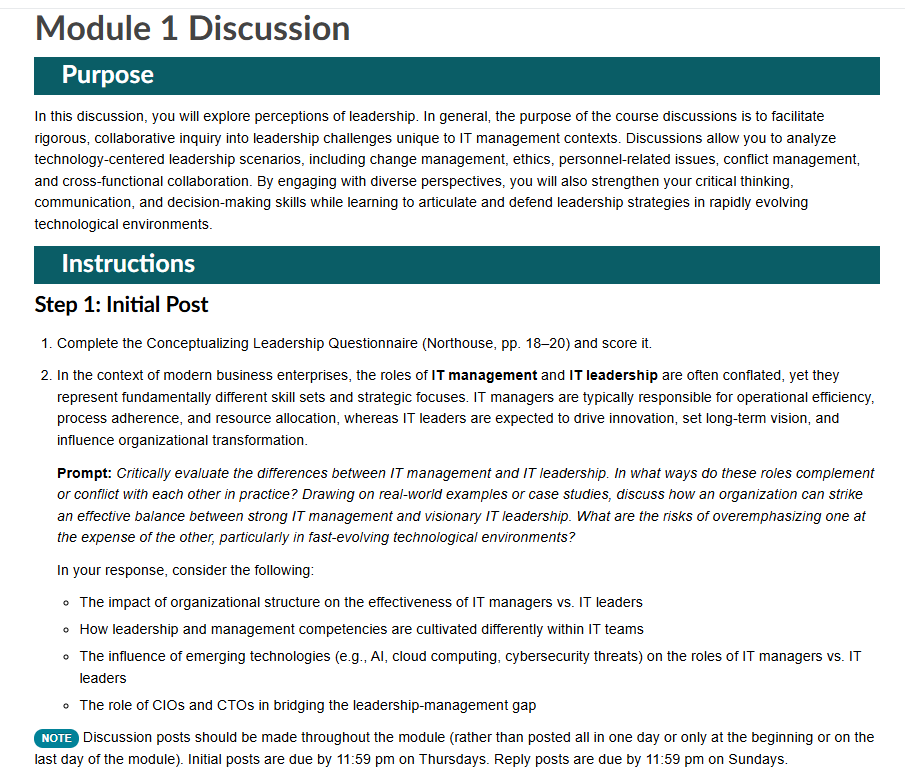
Refer to the screenshots below for the activity’s instructions:
Open accessible text version of previous image
Module 1 Discussion
Purpose
In this discussion, you will explore perceptions of leadership. In general, the purpose of the course discussions is to facilitate rigorous, collaborative inquiry into leadership challenges unique to IT management contexts. Discussions allow you to analyze technology-centered leadership scenarios, including change management, ethics, personnel-related issues, conflict management, and cross-functional collaboration. By engaging with diverse perspectives, you will also strengthen your critical thinking, communication, and decision-making skills while learning to articulate and defend leadership strategies in rapidly evolving technological environments.
Instructions
Step 1: Initial Post
- Complete the Conceptualizing Leadership Questionnaire (Northouse, pp. 18–20) and score it.
- In the context of modern business enterprises, the roles of IT management and IT leadership are often conflated, yet they represent fundamentally different skill sets and strategic focuses. IT managers are typically responsible for operational efficiency, process adherence, and resource allocation, whereas IT leaders are expected to drive innovation, set long-term vision, and influence organizational transformation.
Prompt: Critically evaluate the differences between IT management and IT leadership. In what ways do these roles complement or conflict with each other in practice? Drawing on real-world examples or case studies, discuss how an organization can strike an effective balance between strong IT management and visionary IT leadership. What are the risks of overemphasizing one at the expense of the other, particularly in fast-evolving technological environments?
In your response, consider the following:
- The impact of organizational structure on the effectiveness of IT managers vs. IT leaders
- How leadership and management competencies are cultivated differently within IT teams
- The influence of emerging technologies (e.g., AI, cloud computing, cybersecurity threats) on the roles of IT managers vs. IT leaders
- The role of CIOs and CTOs in bridging the leadership-management gap
NOTE Discussion posts should be made throughout the module (rather than posted all in one day or only at the beginning or on the last day of the module). Initial posts are due by 11:59 pm on Thursdays. Reply posts are due by 11:59 pm on Sundays.
Open accessible text version of previous image
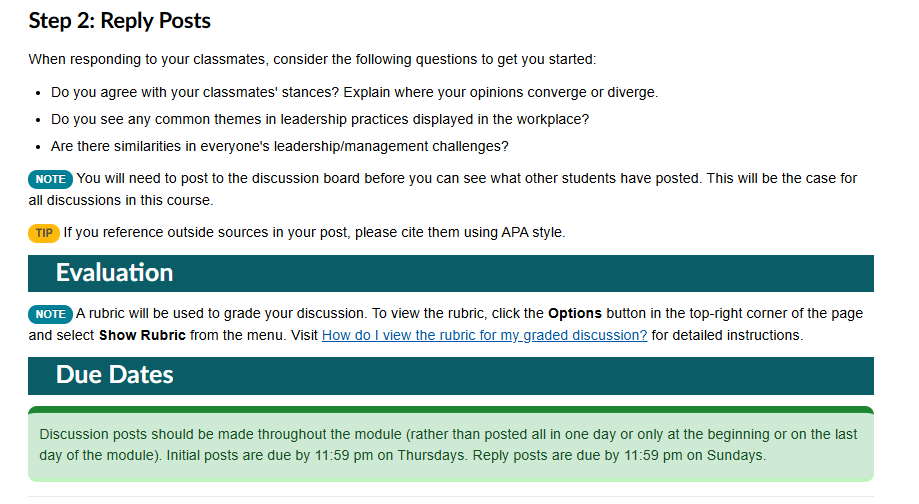
Step 2: Reply Posts
When responding to your classmates, consider the following questions to get you started:
- Do you agree with your classmates’ stances? Explain where your opinions converge or diverge.
- Do you see any common themes in leadership practices displayed in the workplace?
- Are there similarities in everyone’s leadership/management challenges?
NOTE You will need to post to the discussion board before you can see what other students have posted. This will be the case for all discussions in this course.
TIP If you reference outside sources in your post, please cite them using APA style.
Evaluation
NOTE A rubric will be used to grade your discussion. To view the rubric, click the Options button in the top-right corner of the page and select Show Rubric from the menu. Visit How do I view the rubric for my graded discussion? for detailed instructions.
Due Dates
Discussion posts should be made throughout the module (rather than posted all in one day or only at the beginning or on the last day of the module). Initial posts are due by 11:59 pm on Thursdays. Reply posts are due by 11:59 pm on Sundays.
| Criteria | Highly Successful 3 points |
Successful 2 points |
Not Yet Successful 1 point |
Pts |
|---|---|---|---|---|
|
Critical Analysis (Understanding of readings and outside references) |
Discussion postings display an excellent understanding of the required readings and underlying concepts including correct use of terminology. Postings integrate an outside resource, or relevant research, or specific real-life application (work experience, prior coursework, etc.) to support important points. Well-edited quotes are cited appropriately. No more than 10% of the posting is a direct quotation. | Discussion postings display an understanding of the required readings and underlying concepts including correct use of terminology and proper citation. | Discussion postings show little or no evidence that readings were completed or understood. Postings are largely personal opinions or feelings, or "I agree" or "Great idea," without supporting statements with concepts from the readings, outside resources, relevant research, or specific real-life application. | 3 |
| Participation (content) | Discussion postings actively stimulate and sustain further discussion by building on peers’ responses including – building a focused argument around a specific issue or – asking a new related question or – making an oppositional statement supported by personal experience or related research. Posts adhere to the length minimum/maximum in the prompt. | Discussion postings contribute to the class’ ongoing conversations as evidenced by – affirming statements or references to relevant research or, – asking related questions or, – making an oppositional statement supported by any personal experience or related research. Posts are close in length outlined in the prompt. | Discussion postings do not contribute to ongoing conversations or respond to peers’ postings. There is no evidence of replies to questions. Posts do not adhere to the word count stated in the prompt. | 3 |
| Participation (frequency) | Discussion postings are distributed throughout the module (not posted all on one day or only at the beginning or only on the last day of the module) and original responses are posted by 11:59 p.m. on Thursdays. Discussion responses to peers are posted by 11:59 p.m. on Sundays. | Original responses are posted by 11:59 p.m. on Thursdays. Discussion responses to peers are posted by 11:59 p.m. on Sundays. | Discussion postings are at midpoint or later in the module or contributions are only posted on the last day of the module. | 3 |
| Netiquette | Written interactions on the discussion board show respect and sensitivity to peers’ gender, cultural and linguistic background, sexual orientation, political and religious beliefs. | Written interactions on the discussion board show respect and interest in the viewpoints of others. | Written interactions on the discussion board show disrespect for the viewpoints of others. | 3 |
| Coherency/Proofreading | Written responses are free of grammatical, spelling or punctuation errors. The style of writing facilitates communication. | Written responses are largely free of grammatical, spelling or punctuation errors. The style of writing generally facilitates communication. | Written responses contain numerous grammatical, spelling or punctuation errors. The style of writing does not facilitate effective communication. | 3 |
| Total Points | 15 | |||
Keep In Mind
- Identify abstract or challenging concepts that students have historically struggled to understand as opportunities to incorporate media.
- Connect the media script to course resources by paraphrasing relevant information and modeling appropriate attribution in an oral presentation.
- Develop media early in the course development process to allow time to collaborate with your instructional designer and media specialist on the content and presentation.