
Guiding Capstone Progress Through Milestones and Feedback
Overview
Students progress through four capstone milestones, gathering feedback from classmates, their project organization, and the instructor at each stage to refine their work and stay on track.
Why Use This?
Complex projects can feel daunting, especially when students must apply academic knowledge in a professional context. Breaking the capstone into smaller milestones helps them stay organized, address challenges as they arise, and incorporate regular feedback.
Feedback from peers, instructors, and organizational contacts also models the collaborative, iterative processes common in professional settings. Students learn to evaluate and integrate input from multiple perspectives, which is an essential skill in any career field.
⭐ What Students Say
Students say they’ve kept using the strategies from this project to gather feedback on their more critical workplace communications, helping them write more effectively and stay on message. They also say that learning how to ask for and accept feedback, as well as to communicate well in general, often sets them apart from their peers in a positive way.
How Does It Work?
Students complete four milestones throughout the course, submitting work for peer, organizational, and instructor feedback at each stage.
Each milestone includes three parts: a peer discussion where classmates exchange constructive feedback, a brief check-in or retrospective with the student’s capstone organization, and a status report for the instructor summarizing progress and next steps. This structure helps students develop their projects in manageable stages and address issues early.
Open accessible text version of previous image
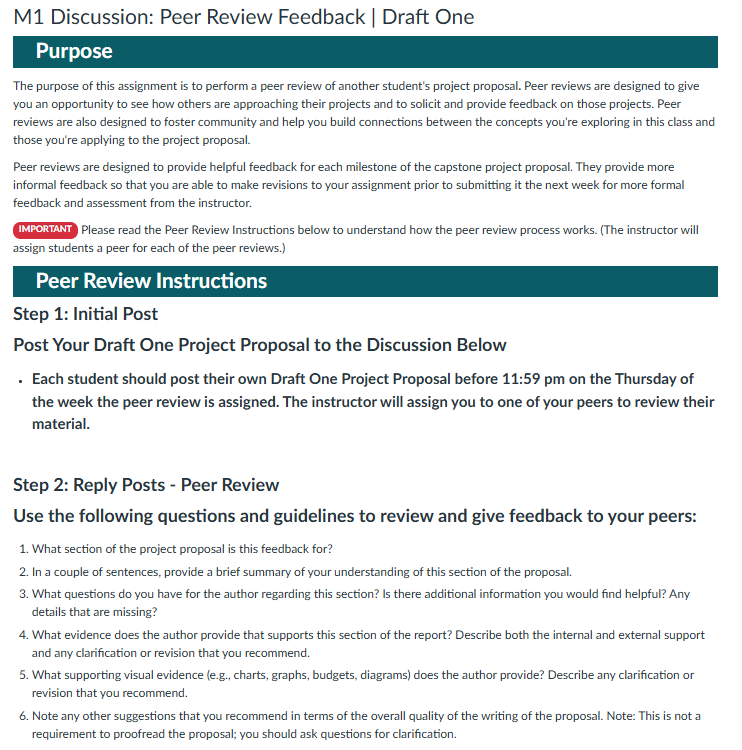
M1 Discussion: Peer Review Feedback | Draft One
Purpose
The purpose of this assignment is to perform a peer review of another student’s project proposal. Peer reviews are designed to give you an opportunity to see how others are approaching their projects and to solicit and provide feedback on those projects. Peer reviews are also designed to foster community and help you build connections between the concepts you’re exploring in this class and those you’re applying to the project proposal.
Peer reviews are designed to provide helpful feedback for each milestone of the capstone project proposal. They provide more informal feedback so that you are able to make revisions to your assignment prior to submitting it the next week for more formal feedback and assessment from the instructor.
Important: Please read the Peer Review Instructions below to understand how the peer review process works. (The instructor will assign students a peer for each of the peer reviews.)
Peer Review Instructions
Step 1: Initial Post
Post Your Draft One Project Proposal to the Discussion Below
- Each student should post their own Draft One Project Proposal before 11:59 pm on the Thursday of the week the peer review is assigned. The instructor will assign you to one of your peers to review their material.
Step 2: Reply Posts – Peer Review
Use the following questions and guidelines to review and give feedback to your peers:
- What section of the project proposal is this feedback for?
- In a couple of sentences, provide a brief summary of your understanding of this section of the proposal.
- What questions do you have for the author regarding this section? Is there additional information you would find helpful? Any details that are missing?
- What evidence does the author provide that supports this section of the report? Describe both the internal and external support and any clarification or revision that you recommend.
- What supporting visual evidence (e.g., charts, graphs, budgets, diagrams) does the author provide? Describe any clarification or revision that you recommend.
- Note any other suggestions that you recommend in terms of the overall quality of the writing of the proposal. Note: This is not a requirement to proofread the proposal; you should ask questions for clarification.
Open accessible text version of previous image
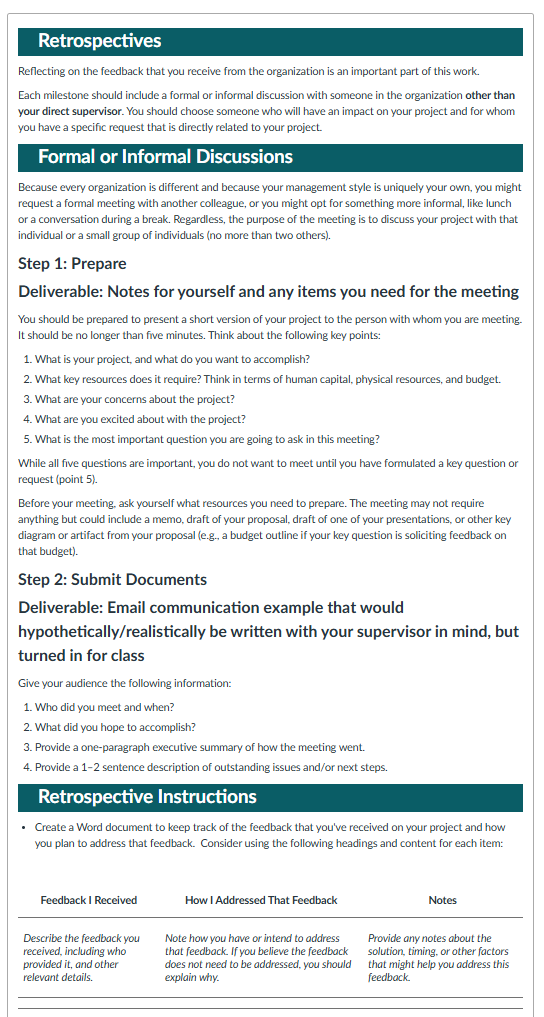
Retrospectives
Reflecting on the feedback that you receive from the organization is an important part of this work.
Each milestone should include a formal or informal discussion with someone in the organization other than your direct supervisor. You should choose someone who will have an impact on your project and for whom you have a specific request that is directly related to your project.
Formal or Informal Discussions
Because every organization is different and because your management style is uniquely your own, you might request a formal meeting with another colleague, or you might opt for something more informal, like lunch or a conversation during a break. Regardless, the purpose of the meeting is to discuss your project with that individual or a small group of individuals (no more than two others).
Step 1: Prepare
Deliverable: Notes for yourself and any items you need for the meeting
You should be prepared to present a short version of your project to the person with whom you are meeting. It should be no longer than five minutes. Think about the following key points:
- What is your project, and what do you want to accomplish?
- What key resources does it require? Think in terms of human capital, physical resources, and budget.
- What are your concerns about the project?
- What are you excited about with the project?
- What is the most important question you are going to ask in this meeting?
While all five questions are important, you do not want to meet until you have formulated a key question or request (point 5).
Before your meeting, ask yourself what resources you need to prepare. The meeting may not require anything but could include a memo, draft of your proposal, draft of one of your presentations, or other key diagram or artifact from your proposal (e.g., a budget outline if your key question is soliciting feedback on that budget).
Step 2: Submit Documents
Deliverable: Email communication example that would hypothetically/realistically be written with your supervisor in mind, but turned in for class
Give your audience the following information:
- Who did you meet and when?
- What did you hope to accomplish?
- Provide a one-paragraph executive summary of how the meeting went.
- Provide a 1–2 sentence description of outstanding issues and/or next steps.
Retrospective Instructions
- Create a Word document to keep track of the feedback that you’ve received on your project and how you plan to address that feedback. Consider using the following headings and content for each item:
| Feedback I Received | How I Addressed That Feedback | Notes |
|---|---|---|
| Describe the feedback you received, including who provided it, and other relevant details. | Note how you have or intend to address that feedback. If you believe the feedback does not need to be addressed, you should explain why. | Provide any notes about the solution, timing, or other factors that might help you address this feedback. |
Open accessible text version of previous image
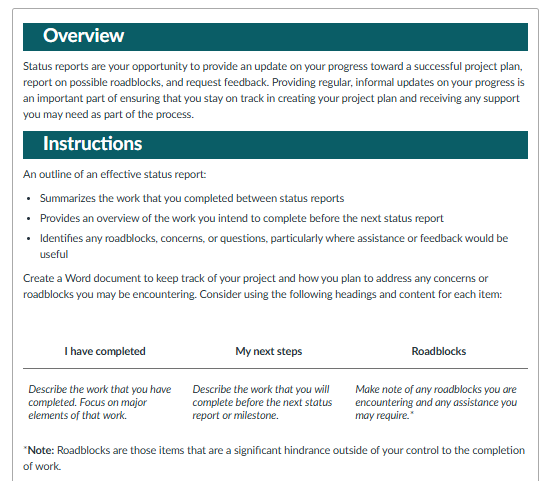
Overview
Status reports are your opportunity to provide an update on your progress toward a successful project plan, report on possible roadblocks, and request feedback. Providing regular, informal updates on your progress is an important part of ensuring that you stay on track in creating your project plan and receiving any support you may need as part of the process.
Instructions
An outline of an effective status report:
- Summarizes the work that you completed between status reports
- Provides an overview of the work you intend to complete before the next status report
- Identifies any roadblocks, concerns, or questions, particularly where assistance or feedback would be useful
Create a Word document to keep track of your project and how you plan to address any concerns or roadblocks you may be encountering. Consider using the following headings and content for each item:
| I have completed | My next steps | Roadblocks |
|---|---|---|
| Describe the work that you have completed. Focus on major elements of that work. | Describe the work that you will complete before the next status report or milestone. | Make note of any roadblocks you are encountering and any assistance you may require. |
*Note: Roadblocks are those items that are a significant hindrance outside of your control to the completion of work.
Keep In Mind
- Provide clear guidance on how to give and apply feedback effectively.
- Set structured timelines so students receive feedback when it’s most useful.
- Model how to balance and synthesize different types of feedback.
- Offer extra scaffolding for undergraduates or students new to project-based learning.
- Encourage reflection on how feedback informs revisions and decisions.