
Presenting Research on Diversity in the IT Workplace
Overview
Students research an issue related to diversity in the IT workplace and create a short narrated presentation to share their findings with their peers.
Why Use This?
This activity builds students’ understanding of ethics and cultural sensitivity in the workplace by asking them to conduct in-depth research on a diversity or discrimination issue in the IT field. Presenting also helps students develop professional communication skills, including public speaking, active listening, and offering constructive feedback—especially when discussing sensitive or complex topics with their classmates.
How Does It Work?
In Part 1, students select a topic related to diversity or discrimination in the IT field from a provided list. They conduct research using scholarly sources and may also collect their own data, such as by using surveys or informal polls in their current or past workplaces.
In Part 2, students turn their research into a narrated slideshow. Clear guidelines outline what to include, such as a problem statement, a summary of the key issue, cited evidence from their research, and possible solutions. Students post their presentations to the discussion board, where the class views them and provides feedback. Each student receives feedback from at least two peers.
Review assignment components by clicking on the tabs:
Open accessible text version of previous image
Overview
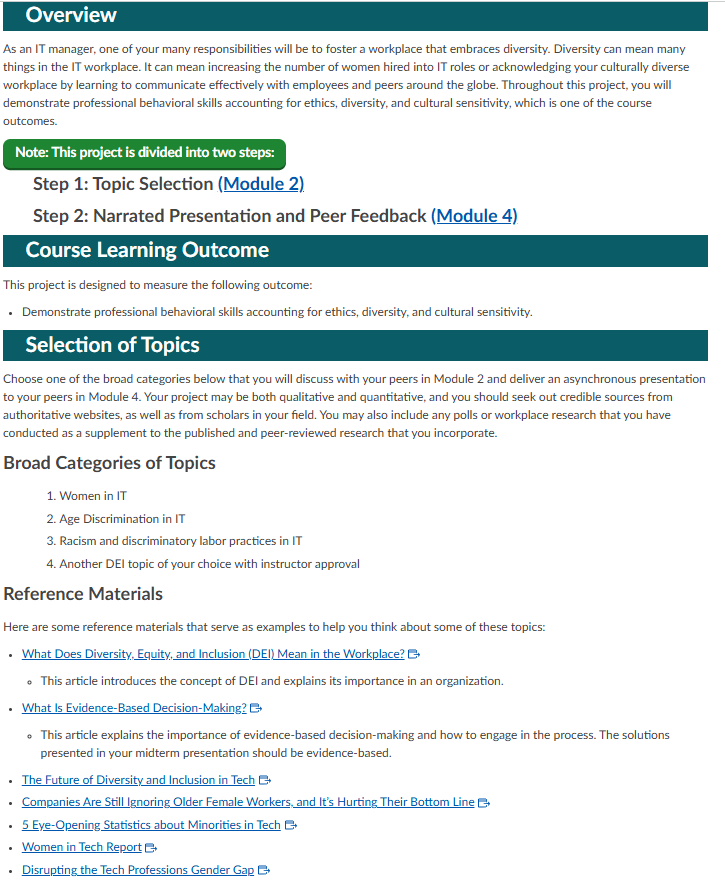
As an IT manager, one of your many responsibilities will be to foster a workplace that embraces diversity. Diversity can mean many things in the IT workplace. It can mean increasing the number of women hired into IT roles or acknowledging your culturally diverse workplace by learning to communicate effectively with employees and peers around the globe. Throughout this project, you will demonstrate professional behavioral skills accounting for ethics, diversity, and cultural sensitivity, which is one of the course outcomes.
Note: This project is divided into two steps:
- Step 1: Topic Selection (Module 2)
- Step 2: Narrated Presentation and Peer Feedback (Module 4)
Course Learning Outcome
This project is designed to measure the following outcome:
- Demonstrate professional behavioral skills accounting for ethics, diversity, and cultural sensitivity.
Selection of Topics
Choose one of the broad categories below that you will discuss with your peers in Module 2 and deliver an asynchronous presentation to your peers in Module 4. Your project may be both qualitative and quantitative, and you should seek out credible sources from authoritative websites, as well as from scholars in your field. You may also include any polls or workplace research that you have conducted as a supplement to the published and peer-reviewed research that you incorporate.
Broad Categories of Topics
- Women in IT
- Age Discrimination in IT
- Racism and discriminatory labor practices in IT
- Another DEI topic of your choice with instructor approval
Reference Materials
Here are some reference materials that serve as examples to help you think about some of these topics:
-
What Does Diversity, Equity, and Inclusion (DEI) Mean in the Workplace?
- This article introduces the concept of DEI and explains its importance in an organization.
-
What Is Evidence-Based Decision-Making?
- This article explains the importance of evidence-based decision-making and how to engage in the process. The solutions presented in your midterm presentation should be evidence-based.
- The Future of Diversity and Inclusion in Tech
- Companies Are Still Ignoring Older Female Workers, and It’s Hurting Their Bottom Line
- 5 Eye-Opening Statistics about Minorities in Tech
- Women in Tech Report
- Disrupting the Tech Professions Gender Gap
Open accessible text version of previous image
Overview
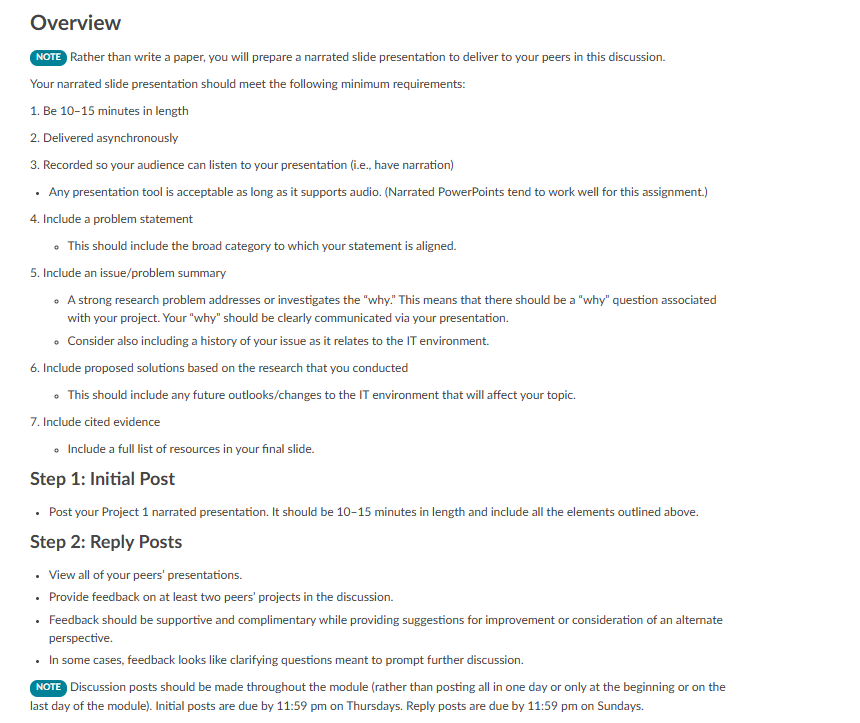
Note: Rather than write a paper, you will prepare a narrated slide presentation to deliver to your peers in this discussion.
Your narrated slide presentation should meet the following minimum requirements:
- Be 10–15 minutes in length
- Delivered asynchronously
-
Recorded so your audience can listen to your presentation (i.e., have narration)
- Any presentation tool is acceptable as long as it supports audio. (Narrated PowerPoints tend to work well for this assignment.)
-
Include a problem statement
- This should include the broad category to which your statement is aligned.
-
Include an issue/problem summary
- A strong research problem addresses or investigates the “why.” This means that there should be a “why” question associated with your project. Your “why” should be clearly communicated via your presentation.
- Consider also including a history of your issue as it relates to the IT environment.
-
Include proposed solutions based on the research that you conducted
- This should include any future outlooks/changes to the IT environment that will affect your topic.
-
Include cited evidence
- Include a full list of resources in your final slide.
Step 1: Initial Post
- Post your Project 1 narrated presentation. It should be 10–15 minutes in length and include all the elements outlined above.
Step 2: Reply Posts
- View all of your peers’ presentations.
- Provide feedback on at least two peers’ projects in the discussion.
- Feedback should be supportive and complimentary while providing suggestions for improvement or consideration of an alternate perspective.
- In some cases, feedback looks like clarifying questions meant to prompt further discussion.
Note: Discussion posts should be made throughout the module (rather than posting all in one day or only at the beginning or on the last day of the module). Initial posts are due by 11:59 pm on Thursdays. Reply posts are due by 11:59 pm on Sundays.
Keep In Mind
- Provide an example of a narrated presentation so students clearly understand the format and can focus on developing their content.
- Acknowledge that discussions about diversity or discrimination can be personal or sensitive, and remind students to approach feedback with professionalism and respect for their classmates.