
Giving Students a Self-Assessment Option
Overview
Students earn the opportunity to self-grade their work if they meet certain assessment requirements.
Why Use This?
This approach supports student growth in a communication course by setting a required level of performance and reducing “perfection” as a barrier to completing speech assignments.
By setting a level students must meet in order to self-assess, the instructor ensures that basic speech skills are practiced and demonstrated. At the same time, the self-grading component reduces the worry and stress of delivering a “perfect” speech. Students are also given the opportunity to reflect on their performance and set goals for the next assessment.
How Does It Work?
The instructor sets a minimum level of mastery that students must acknowledge they’ve met. Students then use a rubric to self-assess their work and provide written justification for their grade. The instructor also reviews the work and provides feedback. However, unless it is clear that a student did not meet the required level of mastery, the instructor honors the student’s self-assigned grade.
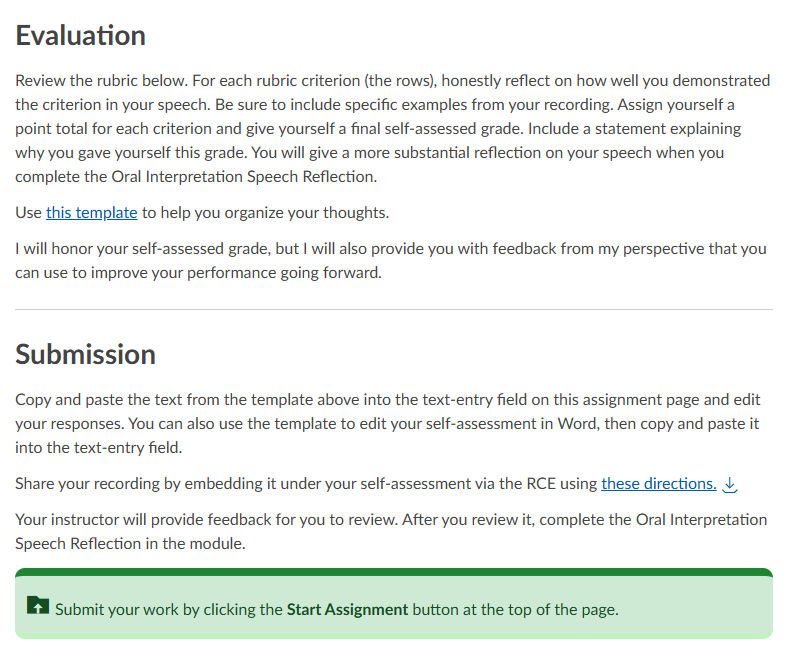
Review the assignment instructions and rubric by clicking on the tabs:
Open accessible text version of previous image
Evaluation
Review the rubric below. For each rubric criterion (the rows), honestly reflect on how well you demonstrated the criterion in your speech. Be sure to include specific examples from your recording. Assign yourself a point total for each criterion and give yourself a final self-assessed grade. Include a statement explaining why you gave yourself this grade. You will give a more substantial reflection on your speech when you complete the Oral Interpretation Speech Reflection.
Use this template to help you organize your thoughts.
I will honor your self-assessed grade, but I will also provide you with feedback from my perspective that you can use to improve your performance going forward.
Submission
Copy and paste the text from the template above into the text-entry field on this assignment page and edit your responses. You can also use the template to edit your self-assessment in Word, then copy and paste it into the text-entry field.
Share your recording by embedding it under your self-assessment via the RCE using these directions.
Your instructor will provide feedback for you to review. After you review it, complete the Oral Interpretation Speech Reflection in the module.
Submit your work by clicking the Start Assignment button at the top of the page.
Open accessible text version of previous image
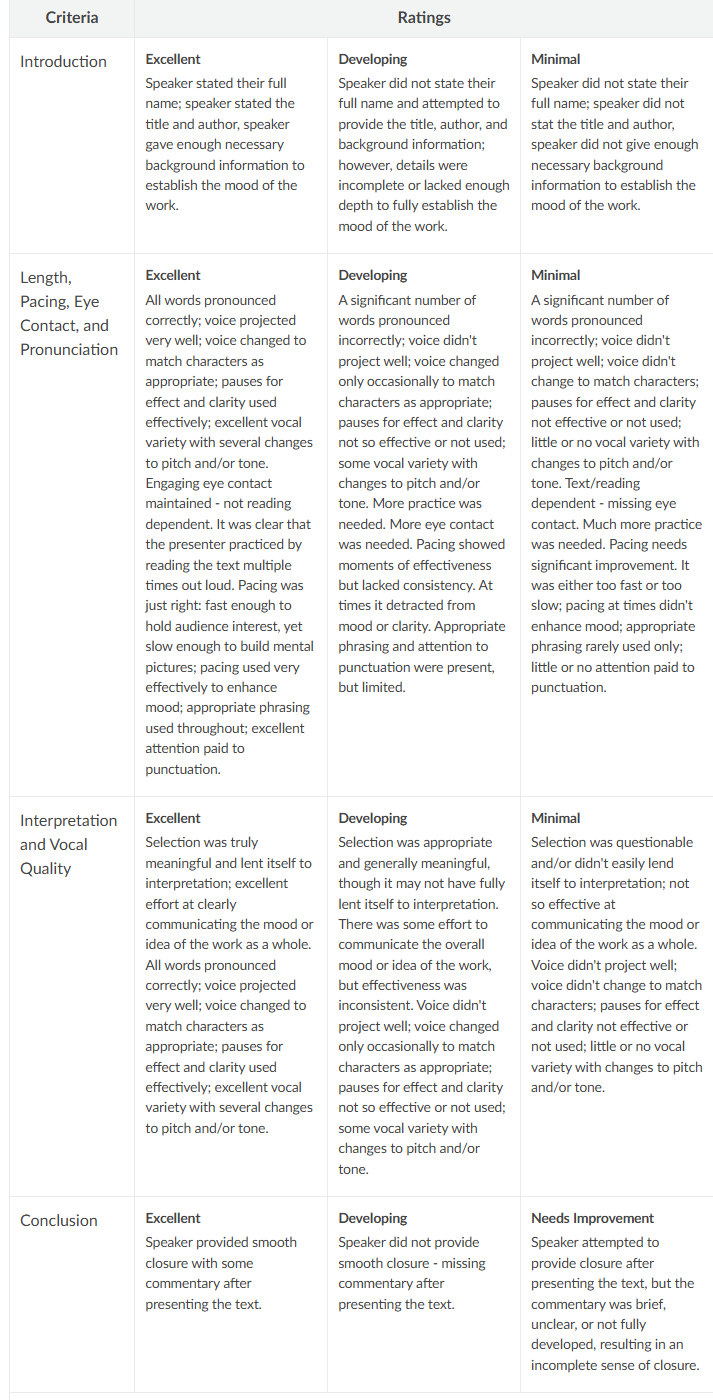
| Criteria | Ratings | ||
|---|---|---|---|
| Introduction |
Excellent
Speaker stated their full name; speaker stated the title and author, speaker gave enough necessary background information to establish the mood of the work. |
Developing
Speaker did not state their full name and attempted to provide the title, author, and background information; however, details were incomplete or lacked enough depth to fully establish the mood of the work. |
Minimal
Speaker did not state their full name; speaker did not stat the title and author, speaker did not give enough necessary background information to establish the mood of the work. |
| Length, Pacing, Eye Contact, and Pronunciation |
Excellent
All words pronounced correctly; voice projected very well; voice changed to match characters as appropriate; pauses for effect and clarity used effectively; excellent vocal variety with several changes to pitch and/or tone. Engaging eye contact maintained – not reading dependent. It was clear that the presenter practiced by reading the text multiple times out loud. Pacing was just right: fast enough to hold audience interest, yet slow enough to build mental pictures; pacing used very effectively to enhance mood; appropriate phrasing used throughout; excellent attention paid to punctuation. |
Developing
A significant number of words pronounced incorrectly; voice didn’t project well; voice changed only occasionally to match characters as appropriate; pauses for effect and clarity not so effective or not used; some vocal variety with changes to pitch and/or tone. More practice was needed. More eye contact was needed. Pacing showed moments of effectiveness but lacked consistency. At times it detracted from mood or clarity. Appropriate phrasing and attention to punctuation were present, but limited. |
Minimal
A significant number of words pronounced incorrectly; voice didn’t project well; voice didn’t change to match characters; pauses for effect and clarity not effective or not used; little or no vocal variety with changes to pitch and/or tone. Text/reading dependent – missing eye contact. Much more practice was needed. Pacing needs significant improvement. It was either too fast or too slow; pacing at times didn’t enhance mood; appropriate phrasing rarely used only; little or no attention paid to punctuation. |
| Interpretation and Vocal Quality |
Excellent
Selection was truly meaningful and lent itself to interpretation; excellent effort at clearly communicating the mood or idea of the work as a whole. All words pronounced correctly; voice projected very well; voice changed to match characters as appropriate; pauses for effect and clarity used effectively; excellent vocal variety with several changes to pitch and/or tone. |
Developing
Selection was appropriate and generally meaningful, though it may not have fully lent itself to interpretation. There was some effort to communicate the overall mood or idea of the work, but effectiveness was inconsistent. Voice didn’t project well; voice changed only occasionally to match characters as appropriate; pauses for effect and clarity not so effective or not used; some vocal variety with changes to pitch and/or tone. |
Minimal
Selection was questionable and/or didn’t easily lend itself to interpretation; not so effective at communicating the mood or idea of the work as a whole. Voice didn’t project well; voice didn’t change to match characters; pauses for effect and clarity not effective or not used; little or no vocal variety with changes to pitch and/or tone. |
| Conclusion |
Excellent
Speaker provided smooth closure with some commentary after presenting the text. |
Developing
Speaker did not provide smooth closure – missing commentary after presenting the text. |
Needs Improvement
Speaker attempted to provide closure after presenting the text, but the commentary was brief, unclear, or not fully developed, resulting in an incomplete sense of closure. |
Keep In Mind
⦁ Define expectations clearly so students understand what is required.
⦁ Design assignments that allow revision, resubmission, or repetition when possible.
⦁ Encourage reflection to help students explain their thinking and learning processes.