
Recapping and Previewing Course Material Using Announcements
Overview
Instructors send out weekly announcements that preview or recap the course material to engage and connect with students.
Why Use This?
Using regularly scheduled announcements is a great way for instructors to show they are invested in the course and their students’ progress.
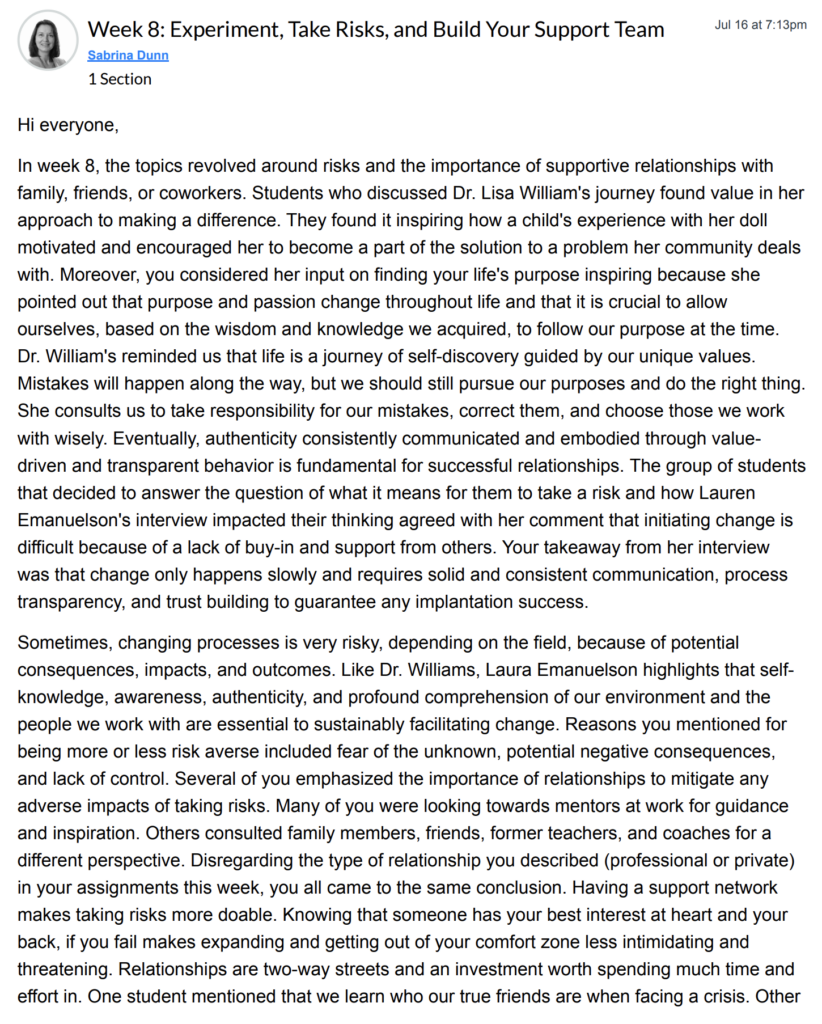
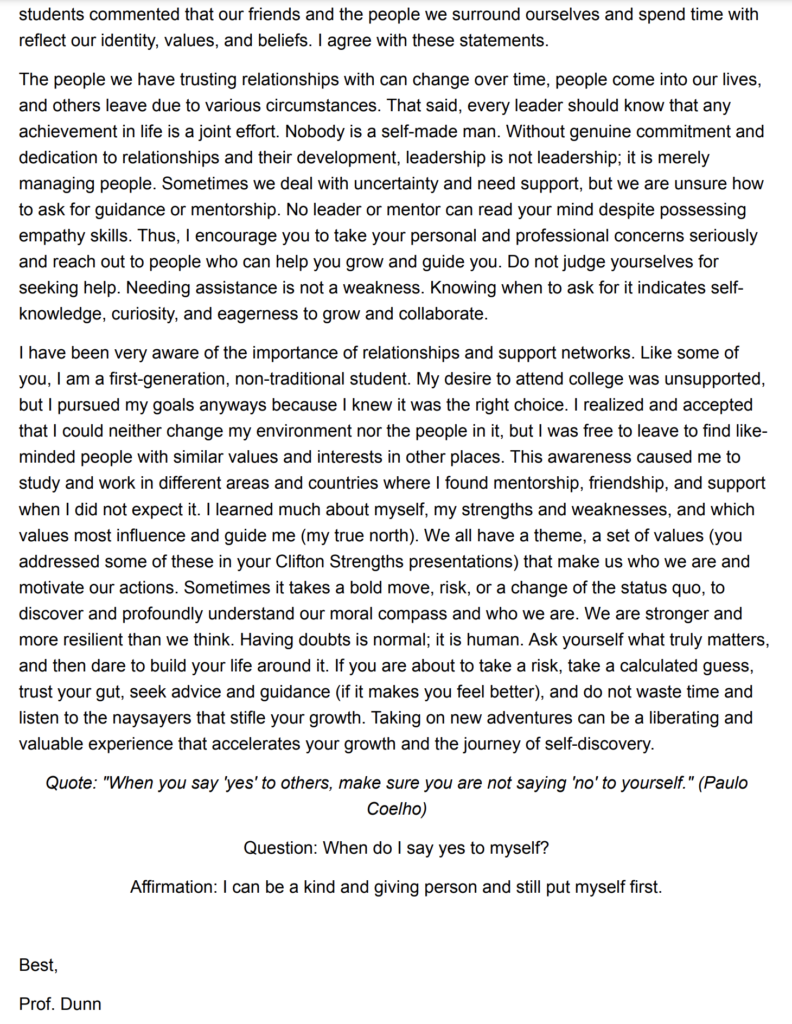
Open accessible text version of previous image
Hi everyone,
In week 8, the topics revolved around risks and the importance of supportive relationships with family, friends, or coworkers. Students who discussed Dr. Lisa William’s journey found value in her approach to making a difference. They found it inspiring how a child’s experience with her doll motivated and encouraged her to become a part of the solution to a problem her community deals with. Moreover, you considered her input on finding your life’s purpose inspiring because she pointed out that purpose and passion change throughout life and that it is crucial to allow ourselves, based on the wisdom and knowledge we acquired, to follow our purpose at the time. Dr. William’s reminded us that life is a journey of self-discovery guided by our unique values. Mistakes will happen along the way, but we should still pursue our purposes and do the right thing. She consults us to take responsibility for our mistakes, correct them, and choose those we work with wisely. Eventually, authenticity consistently communicated and embodied through value-driven and transparent behavior is fundamental for successful relationships. The group of students that decided to answer the question of what it means for them to take a risk and how Lauren Emanuelson’s interview impacted their thinking agreed with her comment that initiating change is difficult because of a lack of buy-in and support from others. Your takeaway from her interview was that change only happens slowly and requires solid and consistent communication, process transparency, and trust building to guarantee any implantation success.
Sometimes, changing processes is very risky, depending on the field, because of potential consequences, impacts, and outcomes. Like Dr. Williams, Laura Emanuelson highlights that self-knowledge, awareness, authenticity, and profound comprehension of our environment and the people we work with are essential to sustainably facilitating change. Reasons you mentioned for being more or less risk averse included fear of the unknown, potential negative consequences, and lack of control. Several of you emphasized the importance of relationships to mitigate any adverse impacts of taking risks. Many of you were looking towards mentors at work for guidance and inspiration. Others consulted family members, friends, former teachers, and coaches for a different perspective. Disregarding the type of relationship you described (professional or private) in your assignments this week, you all came to the same conclusion. Having a support network makes taking risks more doable. Knowing that someone has your best interest at heart and your back, if you fail makes expanding and getting out of your comfort zone less intimidating and threatening. Relationships are two-way streets and an investment worth spending much time and effort in. One student mentioned that we learn who our true friends are when facing a crisis. Other students commented that our friends and the people we surround ourselves and spend time with reflect our identity, values, and beliefs. I agree with these statements.
The people we have trusting relationships with can change over time, people come into our lives, and others leave due to various circumstances. That said, every leader should know that any achievement in life is a joint effort. Nobody is a self-made man. Without genuine commitment and dedication to relationships and their development, leadership is not leadership; it is merely managing people. Sometimes we deal with uncertainty and need support, but we are unsure how to ask for guidance or mentorship. No leader or mentor can read your mind despite possessing empathy skills. Thus, I encourage you to take your personal and professional concerns seriously and reach out to people who can help you grow and guide you. Do not judge yourselves for seeking help. Needing assistance is not a weakness. Knowing when to ask for it indicates self-knowledge, curiosity, and eagerness to grow and collaborate.
I have been very aware of the importance of relationships and support networks. Like some of you, I am a first-generation, non-traditional student. My desire to attend college was unsupported, but I pursued my goals anyways because I knew it was the right choice. I realized and accepted that I could neither change my environment nor the people in it, but I was free to leave to find like-minded people with similar values and interests in other places. This awareness caused me to study and work in different areas and countries where I found mentorship, friendship, and support when I did not expect it. I learned much about myself, my strengths and weaknesses, and which values most influence and guide me (my true north). We all have a theme, a set of values (you addressed some of these in your Clifton Strengths presentations) that make us who we are and motivate our actions. Sometimes it takes a bold move, risk, or a change of the status quo, to discover and profoundly understand our moral compass and who we are. We are stronger and more resilient than we think. Having doubts is normal; it is human. Ask yourself what truly matters, and then dare to build your life around it. If you are about to take a risk, take a calculated guess, trust your gut, seek advice and guidance (if it makes you feel better), and do not waste time and listen to the naysayers that stifle your growth. Taking on new adventures can be a liberating and valuable experience that accelerates your growth and the journey of self-discovery.
Quote: “When you say ‘yes’ to others, make sure you are not saying ‘no’ to yourself.” (Paulo Coelho)
Question: When do I say yes to myself?
Affirmation: I can be a kind and giving person and still put myself first.
Best,
Prof. Dunn
How Does It Work?
Instructors can post announcements during the course, or they can prepare them ahead of time and schedule them to post at a later date.
Keep In Mind
- Be aware of semester-specific language if you plan to reuse announcements. You’ll need to update this language every time the course is offered.
- Try “deep reading,” which is like deep listening. Instead of writing an announcement immediately after grading, take some time to reflect on your students’ work, then compose your announcement.
- Use announcements to connect the class material to students’ lives outside the course. You might emphasize the importance of cultivating unique skills or share your own life or professional experiences.