
Using Storytelling to Support Research on Health Disparities
Overview
Students use a compelling real-world story as the model for a multi-lesson project that explores health disparities and potential solutions.
Why Use This?
Storytelling helps students connect with course material on a deeper level. Research shows that stories boost memory, improve understanding, and activate more areas of the brain than facts alone. Starting with a powerful story engages students right away and helps them make meaningful connections as they work through each stage of a project.
How Does It Work?
Students are introduced to the assignment by watching the documentary Asthma Alley, which highlights the high rates of childhood asthma in the Bronx, New York. Using this story as a model, students select a health condition that shows measurable disparities in a population in a specific location.
Students then research the condition, investigate social and environmental causes of the disparities using scholarly sources, and propose potential solutions. In the final step, they present their findings and recommendations to the class, using an example presentation on the Asthma Alley story as a reference.
Open accessible text version of previous image
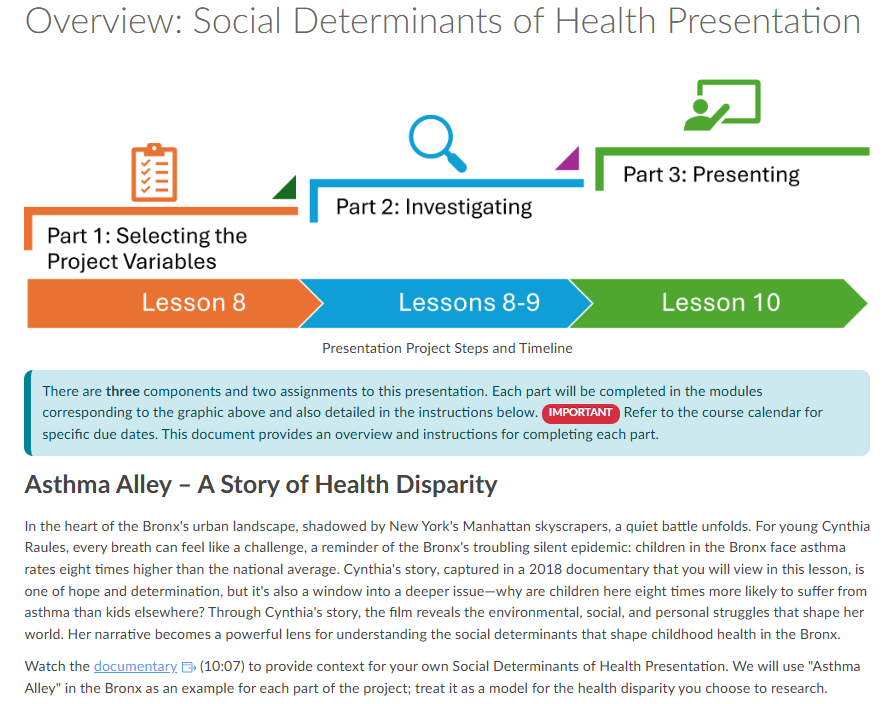
Overview: Social Determinants of Health Presentation
Part 1: Selecting the Project Variables
Lesson 8
Part 2: Investigating
Lessons 8-9
Part 3: Presenting
Lesson 10
Presentation Project Steps and Timeline
There are three components and two assignments to this presentation. Each part will be completed in the modules corresponding to the graphic above and also detailed in the instructions below. IMPORTANT Refer to the course calendar for specific due dates. This document provides an overview and instructions for completing each part.
Asthma Alley – A Story of Health Disparity
In the heart of the Bronx’s urban landscape, shadowed by New York’s Manhattan skyscrapers, a quiet battle unfolds. For young Cynthia Raules, every breath can feel like a challenge, a reminder of the Bronx’s troubling silent epidemic: children in the Bronx face asthma rates eight times higher than the national average. Cynthia’s story, captured in a 2018 documentary that you will view in this lesson, is one of hope and determination, but it’s also a window into a deeper issue—why are children here eight times more likely to suffer from asthma than kids elsewhere? Through Cynthia’s story, the film reveals the environmental, social, and personal struggles that shape her world. Her narrative becomes a powerful lens for understanding the social determinants that shape childhood health in the Bronx.
Watch the documentary (19:07) to provide context for your own Social Determinants of Health Presentation. We will use “Asthma Alley” in the Bronx as an example for each part of the project; treat it as a model for the health disparity you choose to research.
Open accessible text version of previous image
Overview
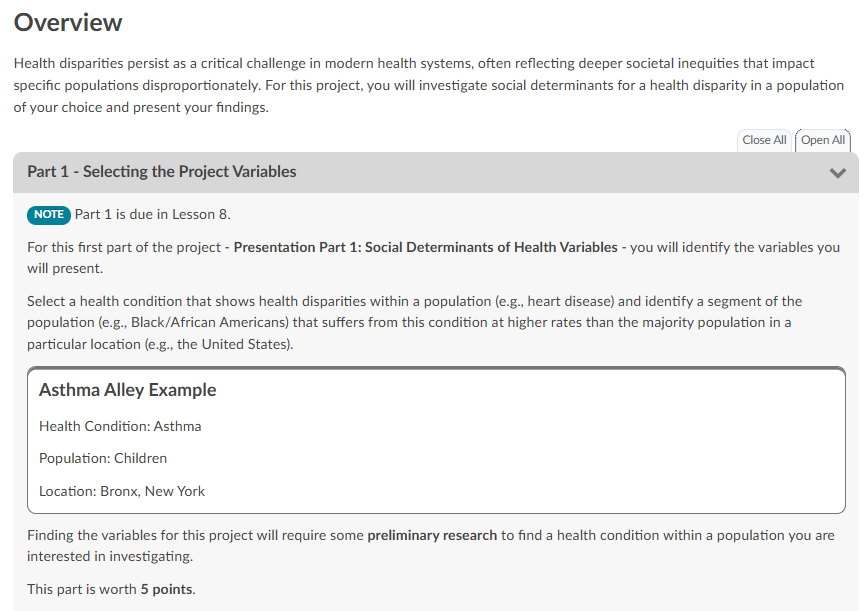
Health disparities persist as a critical challenge in modern health systems, often reflecting deeper societal inequities that impact specific populations disproportionately. For this project, you will investigate social determinants for a health disparity in a population of your choice and present your findings.
Part 1 – Selecting the Project Variables
NOTE Part 1 is due in Lesson 8.
For this first part of the project – Presentation Part 1: Social Determinants of Health Variables – you will identify the variables you will present.
Select a health condition that shows health disparities within a population (e.g., heart disease) and identify a segment of the population (e.g., Black/African Americans) that suffers from this condition at higher rates than the majority population in a particular location (e.g., the United States).
Asthma Alley Example
Health Condition: Asthma
Population: Children
Location: Bronx, New York
Finding the variables for this project will require some preliminary research to find a health condition within a population you are interested in investigating.
This part is worth 5 points.
Open accessible text version of previous image
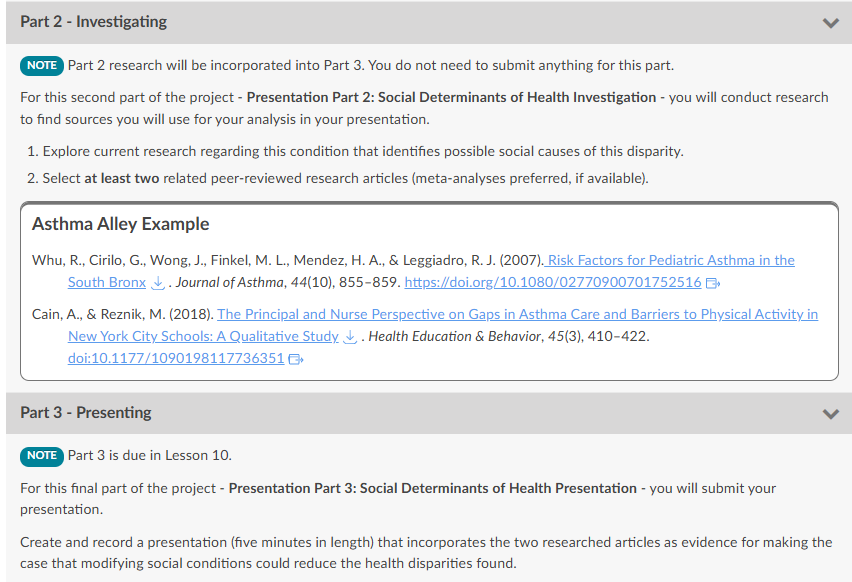
Part 2 – Investigating
NOTE Part 2 research will be incorporated into Part 3. You do not need to submit anything for this part.
For this second part of the project – Presentation Part 2: Social Determinants of Health Investigation – you will conduct research to find sources you will use for your analysis in your presentation.
- Explore current research regarding this condition that identifies possible social causes of this disparity.
- Select at least two related peer-reviewed research articles (meta-analyses preferred, if available).
Asthma Alley Example
Whu, R., Cirilo, G., Wong, J., Finkel, M. L., Mendez, H. A., & Leggiadro, R. J. (2007). Risk Factors for Pediatric Asthma in the South Bronx. Journal of Asthma, 44(10), 855–859. https://doi.org/10.1080/02770900701752516
Cain, A., & Reznik, M. (2018). The Principal and Nurse Perspective on Gaps in Asthma Care and Barriers to Physical Activity in New York City Schools: A Qualitative Study. Health Education & Behavior, 45(3), 410–422. doi:10.1177/1090198117736351
Part 3 – Presenting
NOTE Part 3 is due in Lesson 10.
For this final part of the project – Presentation Part 3: Social Determinants of Health Presentation – you will submit your presentation.
Create and record a presentation (five minutes in length) that incorporates the two researched articles as evidence for making the case that modifying social conditions could reduce the health disparities found.
Open accessible text version of previous image
Important Components of the Presentation:
- Overview of the Health Disparity
- Statistical evidence and comparison with general populations
- Background Context
- The health condition itself; impact on population; geographic/demographic context
- Research Evidence
- Findings from both articles; key social determinants identified
- Analysis of Social Causes
- Detailed examination of social/environmental factors and their impact
- Proposed Solutions
- Evidence-based interventions suggested by the research; potential impact of addressing the social determinants
- Incorporation of visuals as applicable to the audio throughout the presentation
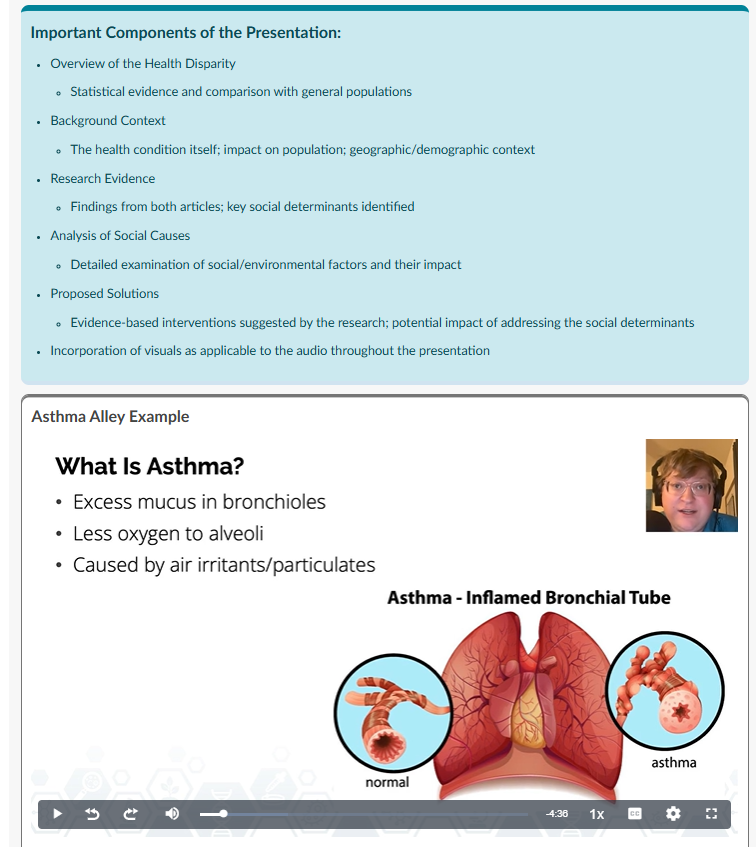
Asthma Alley Example
What Is Asthma?
- Excess mucus in bronchioles
- Less oxygen to alveoli
- Caused by air irritants/particulates
Asthma – Inflamed Bronchial Tube
normal
asthma
Keep In Mind
- Creating a fictional story or case study can take time. Consider using AI to generate story ideas on a topic.
- Emphasize the importance of using scholarly research to support proposed solutions.
- Consider incorporating additional video that covers the instructions for the project.
- Use any story—fictional, real, or personal—to introduce students to a project. The story can be delivered in any medium as well, not just film.
- Aim to engage students both intellectually and emotionally. Look for digital storytelling examples, TED Talks, or personal stories to inspire a narrative of your own.