
Giving Students Options to Explore an Artwork’s Cultural Relevance
Overview
Students are given two options to complete an assessment in which they explore the ways that art encapsulates cultural meaning at a particular time and place.
Why Use This?
Giving students options is always a good thing for learner agency and motivation. It also makes grading more interesting and varied for the instructor.
How Does It Work?
Students write an essay exploring the cultural relevance of an existing artwork or create their own artwork and discuss its implications regarding intercultural communication. The purpose of this assessment is for students to appreciate the symmetrical relationship between art and culture.
In addition to this assessment, many of the other course assessments give students options for how to complete them. Another assessment gives students the choice between writing an essay and producing a video. Likewise, many of the written assessments have two prompts so students can choose what they write about.
Open accessible text version of previous image
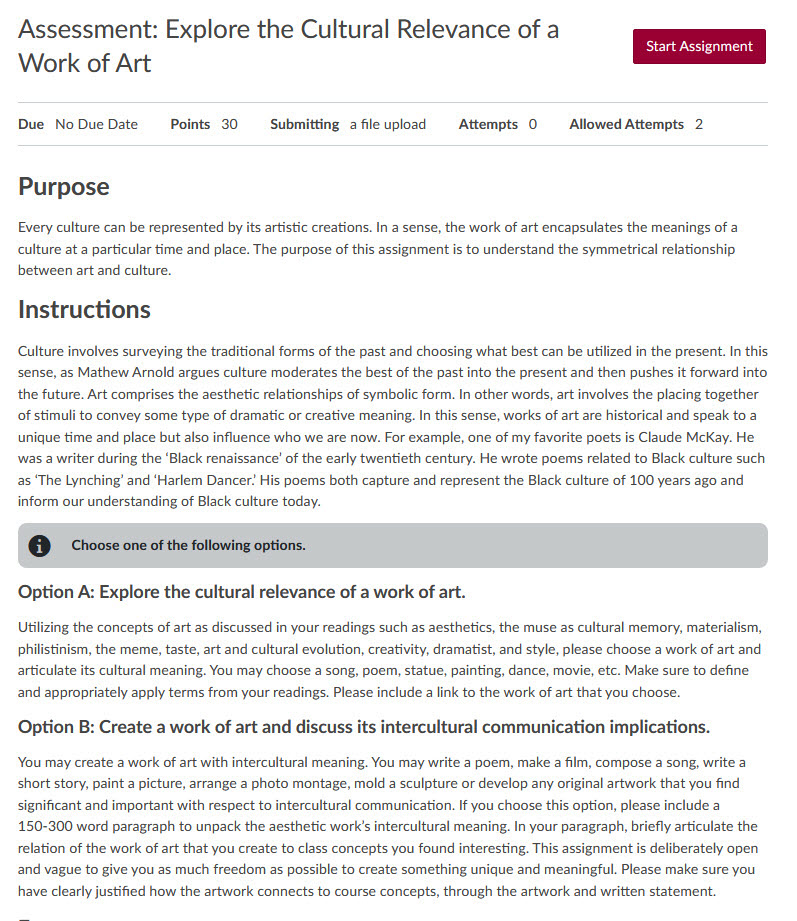
Assessment: Explore the Cultural Relevance of a Work of Art
Purpose
Every culture can be represented by its artistic creations. In a sense, the work of art encapsulates the meanings of a culture at a particular time and place. The purpose of this assignment is to understand the symmetrical relationship between art and culture.
Instructions
Culture involves surveying the traditional forms of the past and choosing what best can be utilized in the present. In this sense, as Mathew Arnold argues culture moderates the best of the past into the present and then pushes it forward into the future. Art comprises the aesthetic relationships of symbolic form. In other words, art involves the placing together of stimuli to convey some type of dramatic or creative meaning. In this sense, works of art are historical and speak to a unique time and place but also influence who we are now. For example, one of my favorite poets is Claude McKay. He was a writer during the ‘Black renaissance’ of the early twentieth century. He wrote poems related to Black culture such as ‘The Lynching’ and ‘Harlem Dancer.’ His poems both capture and represent the Black culture of 100 years ago and inform our understanding of Black culture today.
Choose one of the following options.
Option A: Explore the cultural relevance of a work of art.
Utilizing the concepts of art as discussed in your readings such as aesthetics, the muse as cultural memory, materialism, philistinism, the meme, taste, art and cultural evolution, creativity, dramatist, and style, please choose a work of art and articulate its cultural meaning. You may choose a song, poem, statue, painting, dance, movie, etc. Make sure to define and appropriately apply terms from your readings. Please include a link to the work of art that you choose.
Option B: Create a work of art and discuss its intercultural communication implications.
You may create a work of art with intercultural meaning. You may write a poem, make a film, compose a song, write a short story, paint a picture, arrange a photo montage, mold a sculpture or develop any original artwork that you find significant and important with respect to intercultural communication. If you choose this option, please include a 150-300 word paragraph to unpack the aesthetic work’s intercultural meaning. In your paragraph, briefly articulate the relation of the work of art that you create to class concepts you found interesting. This assignment is deliberately open and vague to give you as much freedom as possible to create something unique and meaningful. Please make sure you have clearly justified how the artwork connects to course concepts, through the artwork and written statement.
Keep In Mind
- Consider using a single rubric that applies to both options for an assessment.
- To mix things up, consider including an assessment where the entire class must answer the same prompt.
Open accessible text version of previous image
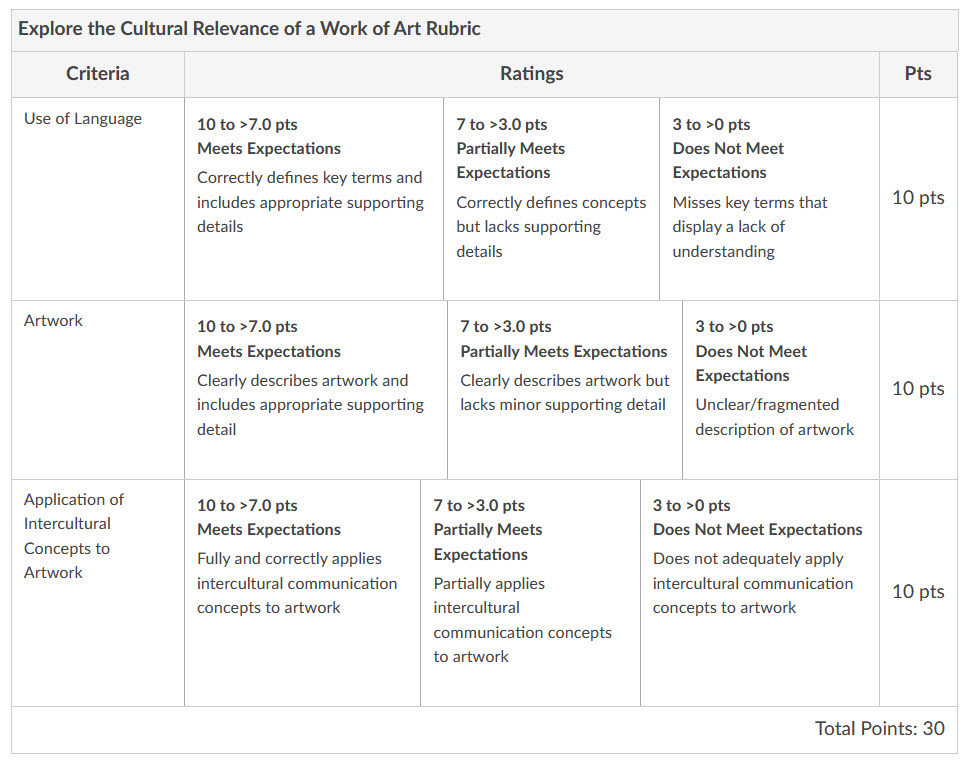
Explore the Cultural Relevance of a Work of Art Rubric
| Criteria | Ratings | Pts | ||
|---|---|---|---|---|
| Use of Language |
10 to >7.0 pts Meets Expectations Correctly defines key terms and includes appropriate supporting details |
7 to >3.0 pts Partially Meets Expectations Correctly defines concepts but lacks supporting details |
3 to >0 pts Does Not Meet Expectations Misses key terms that display a lack of understanding |
10 pts |
| Artwork |
10 to >7.0 pts Meets Expectations Clearly describes artwork and includes appropriate supporting detail |
7 to >3.0 pts Partially Meets Expectations Clearly describes artwork but lacks minor supporting detail |
3 to >0 pts Does Not Meet Expectations Unclear/fragmented description of artwork |
10 pts |
| Application of Intercultural Concepts to Artwork |
10 to >7.0 pts Meets Expectations Fully and correctly applies intercultural communication concepts to artwork |
7 to >3.0 pts Partially Meets Expectations Partially applies intercultural communication concepts to artwork |
3 to >0 pts Does Not Meet Expectations Does not adequately apply intercultural communication concepts to artwork |
10 pts |
Total Points: 30