
Adult Learners
Introduction
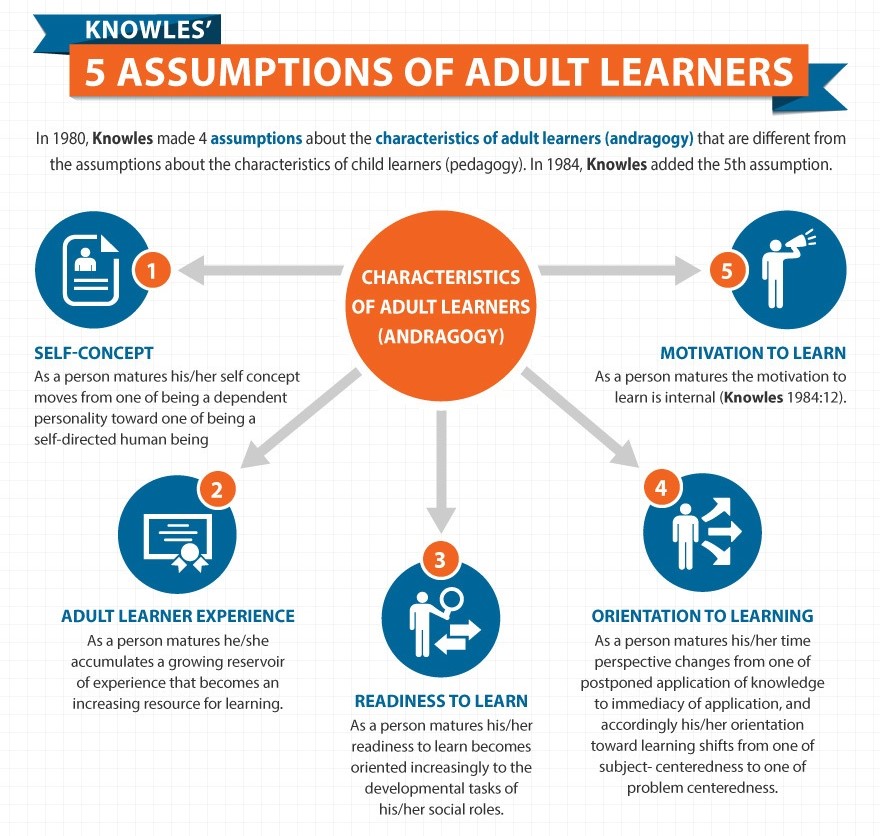
Adult learning theory, or andragogy, is most closely associated with Malcolm Knowles, an educator in the late 20th century who sought to distinguish andragogy (adult education) from pedagogy (children’s education). Since then, principles of andragogy have been applied successfully in some cases to younger learners, and it’s important to recognize that “adult learning” is not simply a matter of chronological age; it is reflective of the motivations and expectations of learners in context and over a continuum of maturity.
That is why it is crucial to know who your learners are—their characteristics, experiences, motivations, and expectations for your course. Are they coming with little knowledge of the topic (for example, in a foundational bachelor’s course), where pedagogical practices may suit them better? Or are they coming from a place of experience (for example, in a higher-level post-graduate course), where adult learning practices would serve them best?
Based on the needs of your students, you can determine the degree to which adult learning principles will resonate with your audience.
A Closer Look
Knowles’ Principles of Andragogy
Based on the assumptions in the graphic above, Knowles outlined five principles of andragogy that you can apply in your classroom practices and assessments:
✔️ 1. Self-Concept: Adults become increasingly self-directed in their learning.
Examples in Practice
- Incorporating choice into assignments, allowing students to select topics, formats, or approaches.
- Providing extended learning opportunities (optional resources, enrichment activities) for students who want to explore course concepts in more depth.
- Designing major projects that allow learners to define their own research question, project focus, or mode of presentation.
✔️ 2. Adult Learner Experience: Adults bring a wealth of life and professional experience that serves as a valuable resource for learning.
Examples in Practice
- Encouraging students to draw from their own experiences when contributing to discussion and reflection assignments.
- Incorporating reflection as part of assessment so students can connect course concepts to their own experiences.
- Designing activities that ask students to apply their own experience in new contexts, such as in this French course activity.
✔️ 3. Readiness to Learn: Adults are most ready to learn when content relates to tasks or roles in their personal, academic, or professional lives.
Examples in Practice
- Explaining the “why” behind learning the content and its relevance to students in course welcome videos, announcements, and lesson overviews.
- Structuring assessments that are authentic and based on real-world settings and situations (case studies, scenarios, service learning or internships, portfolios, capstone projects, etc.).
✔️ 4. Orientation to Learning: Adults prefer learning that is problem-centered and focused on real-world application rather than subject-centered content alone.
Examples in Practice
- Choosing high-impact practices wherein students engage with problems (individually or in groups) that address core concepts, as in this computer science project.
✔️ 5. Motivation to Learn: Adults are primarily motivated by internal factors such as personal growth, curiosity, and the desire to improve their skills or performance.
Examples in Practice
- Providing opportunities for students to set personal learning goals and track their progress.
- Encouraging students to connect course concepts to their own interests, values, or long-term aspirations.
- Offering opportunities for students to apply their learning to projects that matter to them personally or professionally.

Andragogy or Pedagogy?
While this tip sheet focuses on adult learning theory, andragogy does not necessarily fit all students. Pedagogy has and will continue to have an important place in higher education. They are not mutually exclusive, and in many cases, there is overlap in practice. Which theories to incorporate will depend on your audience, the learners.
Northern Illinois University provides a general overview of the differences between andragogy and pedagogy.
Additional Resources
- Adult Learning Theory, A Guide to Theories in Adult Education by the Office of Educational Improvement at the Medical College of Wisconsin
- The Adult Learning Theory – Andragogy – Infographic by e-Learning Infographics
- The Andragogy Approach: Knowles’ Adult Learning Theory Principles by Imed Bouchrika for Research.com